

He made existence sound urgent, and in doing so made philosophy sound dangerous.
In late May 1933, students and professors gathered in Freiburg to hear their new rector speak. The swastika hung over the university, books by Jewish and “un-German” authors were already burning in German squares, and Martin Heidegger, freshly joined to the Nazi Party, stepped forward to tell them that the “self-assertion” of the German university and the destiny of the German people belonged to the same historic mission. He spoke the language of fate and renewal, not footnotes. The man who had asked philosophy to confront anxiety, finitude, and the question of Being now wrapped those themes around a regime that promised rebirth through obedience.
From that moment on, any attempt to understand Heidegger’s thought has had to pass through that hall: the thinker of authenticity standing at a podium under a symbol of dictatorship, asking students to decide resolutely—on the wrong side of history.
Few twentieth-century thinkers have cast a shadow as long—or as troubling—as Martin Heidegger. He did not popularize ideas in the manner of a public intellectual, nor did he found a movement with a clear manifesto. He did something more disconcerting. He took the most basic word in philosophy—“being”—and claimed that Western thought had misunderstood it for two and a half millennia. On the foundation of that accusation he erected a new way of asking what it means to exist at all, one that refused the comfort of abstract systems and returned again and again to anxiety, time, and death.
His achievement was not to solve old puzzles so much as to reopen them. Heidegger made the everyday world—tools, habits, conversations—into evidence that the deepest questions are not found in distant realms but in the way people already live, mostly without noticing what they are doing.
An Ambitious Provincial
Born in 1889 in Messkirch, a small town in southwest Germany, Heidegger came from modest Catholic surroundings and initially prepared for the priesthood. He broke from that path, turned to philosophy, and climbed with unusual speed through the German university system. By his mid-30s he had secured a chair at Freiburg and then moved to Marburg, where his lectures attracted students who would later become formidable thinkers in their own right. He spoke not as a custodian of tradition but as someone impatient with the textbook history of ideas.
Heidegger’s early training in scholastic theology left a mark even as he moved away from it. The question of being—why there is something rather than nothing—had occupied theologians and metaphysicians for centuries. Heidegger thought that most of them had treated it too quickly, as if “being” were an obvious backdrop rather than the most puzzling feature of all. His ambition was to strip away that familiarity, to make the reader feel the strangeness of existing as a finite, time-bound being in a world that preceded and will outlast them.
The Project of Being and Time
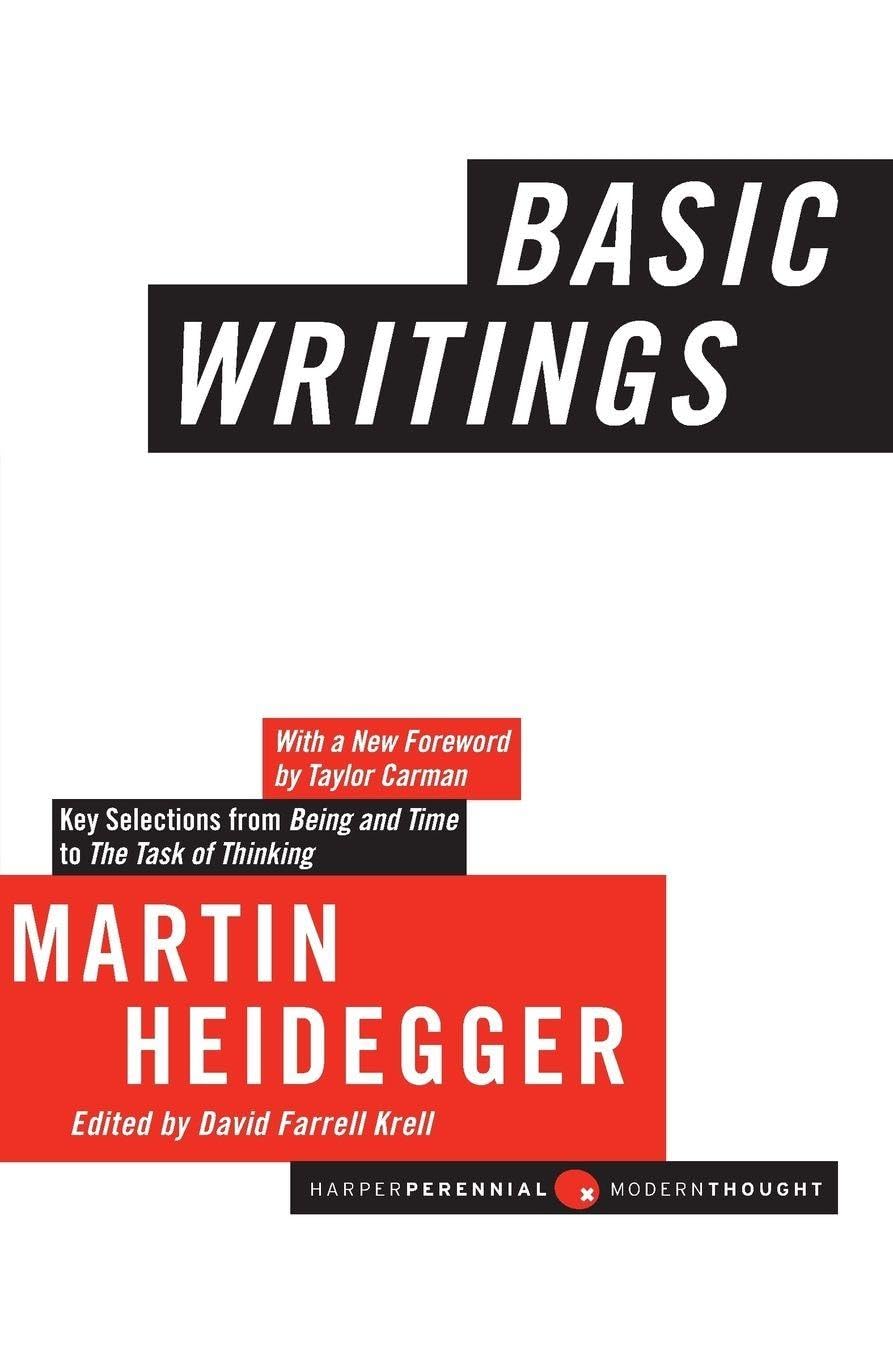
Published in 1927, Being and Time was Heidegger’s attempt to restart philosophy by asking, in a new way, what it means to be. He began not with abstract objects but with the kind of being that asks such questions: human beings, which he renamed Dasein—roughly, “being-there.” The point of the new term was to insist that people are not detached minds looking at a world from the outside. They are already involved, already committed, already at work.
The book’s first move is deceptively simple. To understand what it means to be, look not at isolated things but at how they show up in practical life. A hammer is not primarily a lump of matter obeying physical laws. It is “ready-to-hand,” a tool used without explicit attention when someone is repairing a roof or building a table. Only when it breaks does it become “present-at-hand,” an object that suddenly demands inspection. From this mundane contrast Heidegger drew a general lesson: the world is first encountered as a web of significance, not as a neutral inventory of stuff.
Dasein itself is described through the structures of everyday existence: care, concern, falling into routines, talking, listening, planning. Heidegger insisted that authenticity is not a mystical state reached by escaping the world; it is a way of inhabiting it with clearer awareness of one’s own finitude. Time is central here. Human life is “being-toward-death”: not a morbid obsession, but a recognition that all projects unfold under a horizon that will at some point close.
The Uneasy Politics of Decision
Heidegger’s language of authenticity, decision, and resoluteness did not remain sealed inside the seminar. In 1933 he became rector of Freiburg University and joined the Nazi Party, framing his acceptance speech in terms that linked the “mission” of the German university and people to a kind of historical destiny. The same thinker who had urged philosophy to free itself from inherited metaphysical categories now lent his prestige to a regime that demanded ideological conformity and persecuted colleagues, including his former mentor Edmund Husserl.
He resigned the rectorship after less than a year and later claimed disillusionment, but he never publicly recanted his support, and he remained a party member for the duration of the regime. The question of how deeply his political commitments penetrated his philosophy has haunted his reception ever since. Some critics see an affinity between his rhetoric of destiny, rootedness, and the “people” and the nationalist path he embraced. Others argue that the core analytic of Being and Time can be separated from those choices. The tension has never fully eased.
Language, Poetry, and the “Turn”
After the unfinished project of Being and Time, Heidegger’s thinking shifted. He began to speak less about Dasein and more about the “history of Being” itself. The later writings turn toward language and poetry, especially Hölderlin, in search of a more originary way in which Being might disclose itself. Technology, in this phase, is diagnosed not merely as a set of tools but as a way of revealing the world as a standing reserve of resources, available for control and exploitation.
Heidegger worried that this technological “enframing” reduces everything—including humans—to what can be ordered, optimized, and used. Against this backdrop he proposed a more patient stance: “letting beings be,” listening for the ways in which things might show themselves without immediately being seized as material. The rhetoric is sometimes mystical, sometimes gnomic, and often exasperatingly opaque. Yet it retains a continuous thread from the early work: the conviction that the deepest danger is forgetting the question of Being altogether, treating existence as obvious.
The Teacher and the Shadow
Heidegger’s influence spread through students and readers who took his ideas in directions he might not have anticipated. Phenomenology, existentialism, deconstruction, and various strands of continental theology all bear his imprint. Some, like Hannah Arendt and Emmanuel Levinas, drew heavily on his analyses of existence while sharply criticizing his political blindness. Others used his dismantling of traditional metaphysics to question inherited notions of subject, presence, and identity.
That influence has always come with a warning label. The revelation of his notebooks and documented antisemitic remarks deepened concern that his philosophy and his politics were intertwined in more than accidental ways. The result is a peculiar situation: Heidegger remains indispensable for many of the questions he raised about modernity, technology, and existence, yet citing him often requires an accompanying interrogation of what it means to learn from someone whose political choices were so compromised.
The Enduring Disquiet
Heidegger’s legacy is not a doctrine that can be summarized in a diagram. It is a disturbance. He asked why “being” had been treated as self-evident, why human existence had been reduced either to a rational mind or a biological organism, why technology is so easily taken as pure progress rather than as a way of world-disclosure with its own blind spots. Those questions continue to trouble philosophy, even among those who reject his answers.
What makes him enduring is less any single thesis than a style of questioning that refuses to be satisfied with surface descriptions. He turned the spotlight onto the background: the unnoticed habits, tools, and temporal structures that shape how anything appears in the first place. At the same time, his life forces a second, more uncomfortable reflection: how far a thinker’s insights can be separated from the historical and moral decisions they made.
Martin Heidegger did not resolve that tension. He embodied it. The philosopher who insisted that humans must own their existence as finite beings under a horizon of death left behind a body of work that demands, and resists, judgment. That may be the most unsettling feature of his thought, and the reason it refuses to fade into the background he so urgently wanted philosophy to see.
Recommended Reading



0 comments