

For years, the publishing industry saw digital books coming but had no idea who would end up controlling them. That question exploded into open conflict in January 2010, when Apple unveiled the iPad and, with it, the iBookstore, a direct challenge to Amazon's already-dominant Kindle platform.
What followed wasn't just a fight between two tech companies. It was a battle over who would set the price of books, who would own the relationship with readers, and how much leverage publishers would keep in a market going digital fast.
Amazon's head start, and Apple's pitch
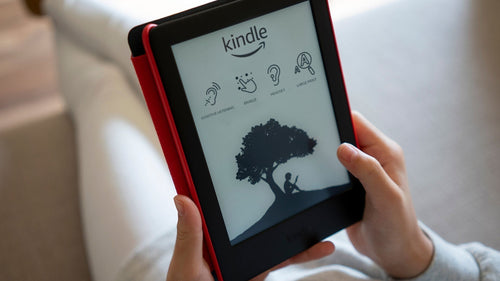
When Amazon launched the Kindle in 2007, it moved quickly to lock down the ecosystem. It controlled the storefront, the hardware, the purchasing experience, and—most consequentially—the price readers saw at checkout. Amazon priced most new releases and bestsellers at $9.99, often selling them at a loss to drive Kindle adoption. Publishers hated the number. They worried it would anchor readers' expectations, making $9.99 feel like the "correct" price for a book regardless of production costs, advances, or editorial investment. Worse, they feared growing dependent on a single retailer that could set terms unilaterally. Amazon wasn't just a bookstore anymore; it was becoming the bookstore, and the store had gone from a building to a website.
Apple offered publishers something they wanted badly: an alternative. Ahead of the iPad launch, Apple needed a real book catalog, and it dangled a different pricing structure to get one, the agency model. Instead of Amazon buying books wholesale and setting whatever retail price it liked, publishers would set the retail price themselves, and Apple would take a 30% commission. For publishers, the appeal was obvious: control. Five major houses—Hachette, HarperCollins, Macmillan, Penguin, and Simon & Schuster—signed on. For Amazon, the shift was a direct threat to the pricing power that had made the Kindle so competitive. Facing publisher pressure, Amazon eventually agreed to adopt agency pricing across those publishers' catalogs as well. The ebook war was underway.
The immediate, visible effect was higher prices. The $9.99 standard broke down; new releases climbed to $12.99, $14.99, and beyond. Readers noticed and complained. Publishers argued books needed to hold their value; Amazon argued that low prices sold more books and grew the overall market. Both arguments had merit, but neither side was really arguing about the price of one book. They were fighting over who got to set prices at all.
The lawsuit
In April 2012, the U.S. Department of Justice sued Apple and five publishers, alleging they had conspired to raise ebook prices and kill retail price competition. It was a case where the publishing industry's desire to weaken Amazon collided head-on with antitrust law.
All five publishers settled rather than fight. Apple did not. The case went to trial, and in 2013 a federal judge ruled that Apple had orchestrated the publishers' coordinated shift to agency pricing—a scheme, not a coincidence. Apple appealed and lost again in 2015; the Supreme Court declined to hear a further appeal in 2016, and Apple paid $400 million in consumer damages and legal fees as part of a prior settlement.
What the fight was really about
Publishers, in trying to blunt Amazon's pricing power, had helped hand Apple a foothold, and ended up in legal jeopardy for it. Meanwhile Amazon's dominance barely dented: its market share, customer data, search visibility, and distribution muscle remained enormous. Publishers learned a hard lesson, challenging Amazon was far easier than replacing it, and that problem never really went away.
Apple, for its part, never became the dominant ebook retailer. The iPad succeeded wildly as a device, but the Kindle held its ground as the reading platform of choice, and Amazon's broader retail ecosystem proved nearly impossible to dislodge. Still, Apple's intervention mattered: it proved publishers could use rival platforms as leverage against a powerful retailer, and it showed how fast a tech company with no publishing history could become a central player in a cultural industry it didn't build.
The Apple-Amazon feud faded from headlines, but the underlying question never resolved. Publishers still negotiate with Amazon today over pricing, visibility, advertising, audiobooks, and subscription bundles like Kindle Unlimited. The technology keeps changing—audiobooks, e-readers, subscription models, AI-driven recommendations—but the core question hasn't: who decides how books reach readers?
That question matters because whoever controls distribution controls discovery. And in publishing, discovery is power.
The ebook war was never really about whether a book should cost $9.99 or $14.99. It was the moment publishing discovered that its future would be shaped not just by publishers and booksellers, but by the technology companies controlling the screens through which readers increasingly meet the written word.


0 comments