

The temperature at Waterloo on June 18, 1815, was unremarkable. What was remarkable was that Napoleon Bonaparte, the man who had outmaneuvered the greatest generals in Europe for two decades, who had redrawn the map of the continent with his campaigns and remade France with his reforms, spent much of the decisive battle of his career unable to get out of bed. He was forty-five years old and suffering from a combination of hemorrhoids, a urinary infection, and what several historians have since identified as acromegaly, a hormonal condition that may have been quietly undermining his judgment and stamina for years. The orders came late. The timing was wrong. Wellington held. By evening, it was over, and the man whose dramatic return from Elba had terrified every crowned head in Europe was finished, this time permanently, exiled to a rock in the South Atlantic from which there would be no second return. He spent his remaining six years dictating his memoirs, carefully constructing the legend that would outlast the defeat, and the legend, it turned out, was the most durable conquest of all.
Napoleon Bonaparte (1769–1821) is the most written-about secular figure in history, which tells you something about the scale of what he did and nothing at all about how to evaluate it. He rose from modest Corsican origins to crown himself Emperor of the French by forty, reshaped the political map of Europe through campaigns of breathtaking audacity, and left behind a legal code, an educational system, and an administrative apparatus that France still operates within today. He also left behind somewhere between three and six million dead, a continent exhausted by two decades of war, and a revolutionary promise of liberty, equality, and fraternity that he had appropriated, manipulated, and ultimately betrayed in the service of his own unappeasable ambition. The question of which of these Napoleons is the real one has been generating arguments for two centuries without running out of energy.
What makes Napoleon so resistant to final judgment is that the contradictions are structural, built into the foundations of everything he did. The man who spread the principles of the French Revolution across Europe did so at bayonet point, installing his brothers on foreign thrones and demanding the personal loyalty that republics are supposed to make obsolete. The military genius who won Austerlitz and Jena ordered the invasion of Russia with a strategic overconfidence that his own record should have made impossible. The reformer who modernized France's legal and institutional foundations ruled as a despot who suppressed the press, rebuilt a nobility, and made himself emperor with plebiscites his own officials had ensured would produce the right result. He contained his contradictions not by resolving them but by moving too fast for them to catch up, and when he finally slowed down, they destroyed him.
Alan Strauss-Schom, whose eleven acclaimed books on French and European history have made him one of the foremost authorities on the Napoleonic era writing in English, brings to these contradictions the sustained analytical attention they have always deserved and rarely received. His biographies do not settle for the caricature of Napoleon as either conquering hero or megalomaniacal tyrant, because Strauss-Schom understands that the caricatures, however emotionally satisfying, explain nothing. What he offers instead is the harder and more rewarding work of tracing the interplay between Napoleon's genuine genius and his catastrophic hubris, between the visionary administrator and the man who could never quite believe that the rules governing everyone else applied to him. In this conversation, he helps us see Napoleon not as a relic of a distant era but as a mirror, still uncomfortably clear, in which timeless questions about ambition, power, and the distance between a leader's vision and his capacity for self-knowledge refuse to stop reflecting something recognizable.
Charles Carlini: You’ve been teaching, lecturing, and writing about Napoleon Bonaparte and French history since the 1970s. As an American, what first drew you to the study of French and European history? What drew you to Napoleon in particular?
Alan Schom: My interest in France, England, and modern Europe grew from several sources. During my childhood, I had access to books on these subjects in our family library. Then, as a freshman at the University of California, Berkeley, I had the good fortune to take a marvelous course on European history with Professor Adams. He was fluent in all the principal languages and made the course come alive. And then my first lecturer in French literature added another magical touch for me. Madame Hester was a superb teacher, that very rare sort of person one comes across from time to time. I became fascinated by French history and, in particular, its most bizarre century—the 19th.
CC: Napoleon is among the most studied military leaders in history. What prompted you to write a new biography of the infamous French emperor? What steps did you take to make Napoleon: A Life stand out in the field of Napoleon studies?
AS: I only became interested in Napoleon while teaching an undergraduate two-semester course on modern French history (1789 to the present). When drawing up a reading list for my students, I was unable to find a remotely complete, professionally written biography. I dodged the challenge of providing that biography myself for several years before beginning the ten solid years of research and writing required for its completion.
On the other hand, I took no special steps to make my biography different from other works. I merely decided to do what all previous scholars had shirked—gradually going through every manuscript, document, memoir, etc. relating to Napoleon that could be found in the French Archives and the Bibliothèque Nationale. I aimed to cover every aspect of his life and career, and as impartially as possible. I was not in any manner emotionally involved. I am a professional historian with 8 years of university study, and I am trained to do just this. I merely listed, so to speak, everything good that Napoleon did, including the negative aspects, and let those facts speak for themselves. I had some good friends in the main Napoleonic Society in Paris, SOUVENIRS NAPOLONNIENS, most of them descendants of Napoleon's officials and officers. Prince Napoleon Murat gave a luncheon in Paris in my honor when Jean Tulard of the Académie Française was introduced to me. I was subtly informed that my favorable biography of the great man would make me an officer of the Legion of Honour. Everyone was very kind, but I was determined to tell the full truth as best I could. (For what it is worth, I had originally planned on a career in law with the intention of being a judge, like other members of my family.) I have attempted to be as impartial as I could, and therefore just listed the facts—the constant wars, the unending casualty figures (three million dead according to one French physician), the hundreds of villages bombarded and burnt, the hundreds of thousands of civilian war refugees across the face of Europe forced to flee Napoleon's mostly completely unnecessary wars. The figures were there in the Archives, and I merely recorded them in my book. Regardless of the topic of my current work, I write and research to better understand why and how historical events occur, and why the people who create those events do so. In the end, I wrote the first complete biography of Napoleon, but the full impact of this undertaking only sank in a few years after HarperCollins published it. It is quite amazing that this had not been written much earlier, during the intervening two hundred years since Napoleon's fall. I have attempted to write a detached study of Napoleon, free of all myth, in the simplest, most readable style possible.
CC: Some critics accused Napoleon: A Life of being too condemning of Napoleon and failing to present an objective overview of his career. Were you expecting this reaction? Do you stand by the tone of the biography, or do you think you should have been more impartial?
AS: I would not change a word of it. I researched it carefully and took ten years to do so. The loudest critics of my books fall into two categories: fan clubs composed of the general public (not professional historians or trained scholars with academic degrees in modern French history); some of them don’t even speak French fluently, such as the International Napoleonic Society. They are simply genuine devotees of Napoleon. I have met their senior officers at a reception in Paris and found them to be businessmen, insurance salesmen, and the like. Their president, Proctor Jones, was, in fact, a friend of mine, a lawyer, but not a trained historian. He hired a man to translate French books into English for him. The second category of critics are the Jean Tulards—professional, academically accredited historians, who always take a pro-Napoleon stance. If Tulard had criticized Napoleon seriously, he would have been removed from his university chair and most certainly never named to the Académie Française. I almost died in France, and the awareness of the brevity of life incited in me a desire to know what history is really about, what really happened, who did what, and why. Life is too short for fairy tales. "Napoleon Bonaparte" is today a billion-dollar industry, and if people like Tulard say anything seriously critical of their national hero, they haven't much of a future.
CC: Your introduction to Napoleon: A Life leads with an anecdote about your visit to Borodino, site of the bloody 1812 battle of the same name. What insights, if any, did you gain by visiting some of the actual sites of Napoleon’s battles?
AS: I did not visit Borodino, but my friend Baron de Meneval did, and he wrote to me of his experience. I have, however, visited the battlefields across northern Italy and, more importantly, Waterloo. Visits to the actual site of events are crucial to understanding what really transpired. Even more important is the necessity to visit the palaces, buildings, and rooms that Napoleon knew. I visited the Senate in the Luxembourg Palace (where one of Napoleon's thrones still stands), the École Militaire, Fontainebleau, Rambouillet, Malmaison, Compiegne, Toulon, etc. I also visited many of the fortresses where he served as a young officer, as well as the entire coastal installations from Boulogne on down to the Spanish frontier, and, of course, I visited his sister's house in Paris, now serving as the British Embassy. I could never have understood Napoleon without visiting those places. The heads of each facility have personally facilitated my work. Malmaison was especially poignant, as was the room at Fontainebleau in which Napoleon attempted to commit suicide. Every historian has their own research methods, and this is mine.
CC: After he escaped from Elba, Napoleon faced practically insurmountable odds; why, then, did he persevere with his attempted conquest? At this stage, did he truly think himself to be in the right, or was he more concerned with securing his own legacy?
AS: Why did Napoleon persist after Elba? Why does any powerful leader, political or military, attempt to remain in office as long as possible? Is it ego, the wish to remain number one, and to hold supreme power? War and dictatorial power over many millions of people were the only realities he knew. Inwardly, he was a shallow man, so he would be directionless without this power. Why are all my books about Napoleon still suppressed in France? Why are Tulard and his colleagues so determined to silence not just me but anyone who does not toe the Tulard line?
CC: Your account of Napoleon's military career is famously critical; the epilogue to Napoleon: A Life states that “the memory of Genghis Khan paled in comparison” to Napoleon’s butchery. In your opinion, has there been an effort to “cover up” or “whitewash” Napoleon’s less savory deeds?
AS: On the battlefields, Napoleon was no more brutal than anyone else. The continued slaughter on all sides was horrific, and I don't think there has been any attempt to conceal what was already well known. But during his campaigns, Napoleon always understated his own casualties, which perhaps the other side did as well. Where Napoleon was brutal, however, was in the constant annual draft of 80,000 young men and even schoolboys. This was a relentless drain on the French people. What is played down is that these recruits were not volunteers but were forced at bayonet point to serve France. Napoleon was literally "harvesting" the youth of the country. But he could not hide the fact that large numbers of men never returned. He did, to an extent, conceal the losses in the Egyptian and Spanish campaigns. Certainly, the colossal losses were never published in the strictly regulated press of the day. But the most horrendous losses of all, during the Russian campaign, were self-evident because only 50,000 men returned out of 500,000 (including the units of their allies). Stunned Parisians soon knew the truth, and not even Napoleon Bonaparte could prevent that. Every village in the land knew the score, just as during the First World War, every village posted the names of those who had fallen, and those numbers were frighteningly high. As for the atrocities of war, all sides were guilty of rape, pillage, wanton torture, and murder. But in the final analysis, what Napoleon must largely bear responsibility for was the destruction of thousands of villages and towns across the whole of Europe, from the Baltic to the Adriatic—the result of his perpetual lust for war. It is impossible to calculate the civilian deaths, and no French source even mentions the many hundreds of thousands of innocent refugees—victims of "the Napoleonic Wars," as they are referred to in England. Unlike that Mongolian invader, Napoleon kept coming back, time and again, raiding Italy, in battle after battle, then returning to the German and Austrian states again and again for over fifteen years. Ghengis Khan was not nearly as destructive. As far as I am concerned, I see very little difference between the Hitler mentality and that of Napoleon—both were war lovers. If anything has been whitewashed by French historians today, it is the untold civilian tragedy.
CC: Trafalgar: Countdown To Battle chronicles the lead-up to and results of the 1805 naval battle in which the British defeated the French/Spanish fleet. How did Villeneuve’s defeat at Trafalgar influence the following 10 years of the Napoleonic Wars? What prompted you to write a book covering this battle specifically?
AS: You ask about my book, Trafalgar and Villeneuve's defeat that October day in 1805. Cornwallis and Nelson not only shattered the French fleet but also shattered naval morale for decades to come, as it was not revived until the end of the 19th century. I wrote about this subject principally because I wanted to understand just how serious Napoleon's attempted invasion of England was, an attempt Napoleon subsequently denied. I discovered an enormous amount of previously unpublished material, chiefly on the entire invasion preparations along the Channel, which proved incontrovertibly Napoleon's serious effort to carry out this invasion, to the point of bankrupting the French Treasury in order to fund it; Napoleon even sold the rights to Louisiana to the United States, an event which went down in history as the “Louisiana Purchase," and he used money from the transaction for that invasion. I believe my book may be the first in English to describe this operation. Napoleon lived in a world of "dreams," all of which collapsed when his invasion of Egypt was a total disaster, and he left two-thirds of his army behind. His invasions of England, Spain, and Russia were also failures. Napoleon had little understanding of reality.
CC: Napoleon himself commented that his military victories would eventually be forgotten, but the Napoleonic Code he created would live forever. What, in your opinion, was the extent of the Code’s influence on Western society?
AS: Napoleon's Civil and Criminal codes were drawn up to protect the rich and powerful, but especially to ensure supreme control of society. The Code is practiced only in France and its territories. According to it, the accused is always guilty until they can prove otherwise. This begins at the local village/police court, where the accused is summoned, usually by a young police officer with, at best, a high school education. The accused individual is not allowed to have a lawyer present and generally not even permitted to speak. If the village or town police decides that the person is guilty, he or she doesn't even know it until summoned to another court for sentencing, for the police can pronounce judgment and condemn the accused.
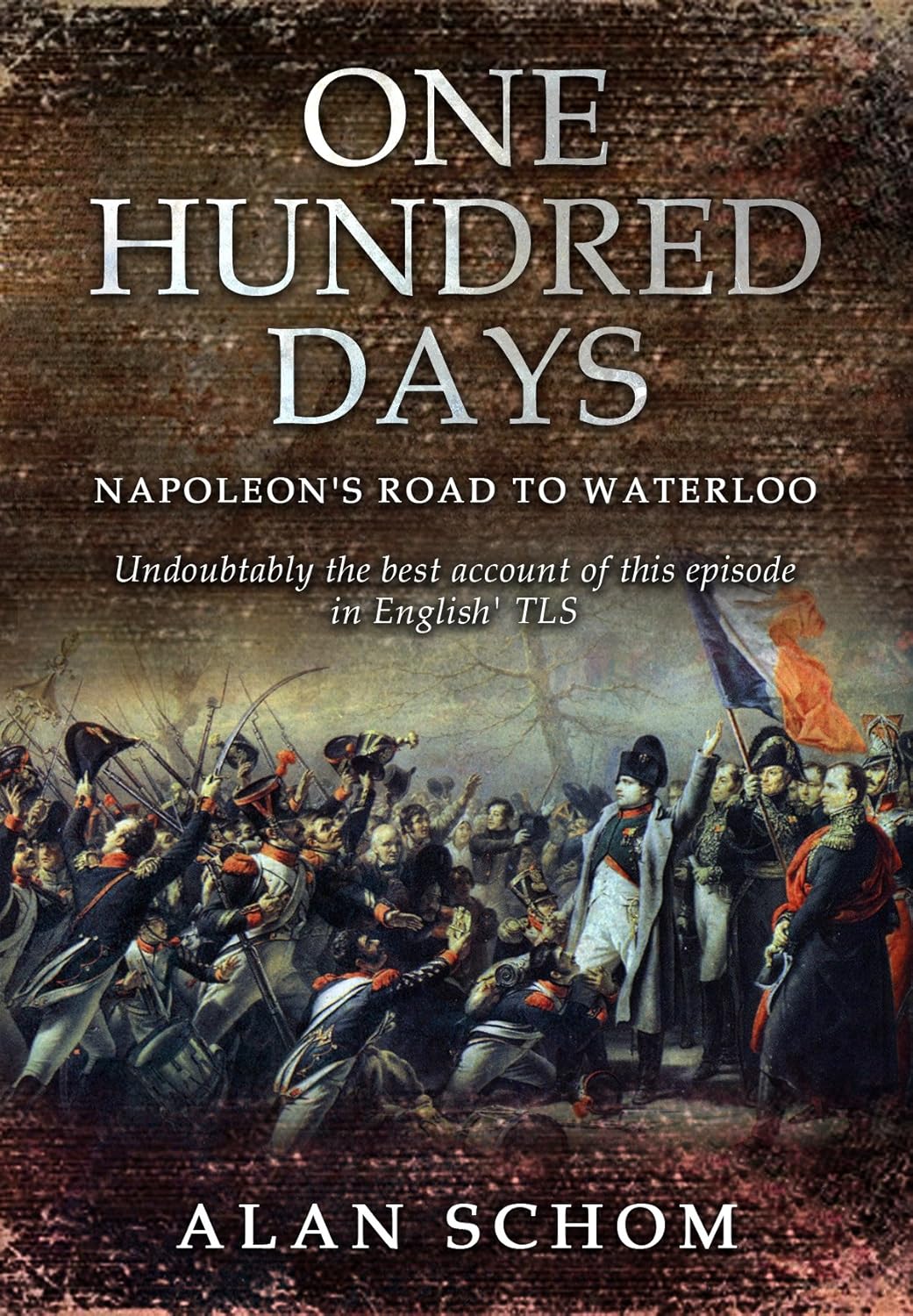
CC: In writing Napoleon: A Life, along with Trafalgar and One Hundred Days, what sort of resources did you draw on for your research? Are there any works besides your own that you would recommend for scholars looking for more details on Napoleon’s life and career?
AS: My sources: The Archives Nationales and the manuscripts and works in the Bibliothèque Nationale in Paris. I used French archival material alone in the research of my book. My biography is the first complete one, including all aspects of Napoleon’s life, and in addition to the above, I included some 500 books and articles. Jean Tulard certainly has the greatest knowledge of every single fact surrounding Napoleon but lacks analytical understanding of their significance. On the other hand, he has produced some very useful bibliographies and a super biographical dictionary on the subject. Professor Alan Forrest of the University of York has written a smaller but useful biography of Napoleon's official career. Frédéric Masson, the most important French historian, with a real objective knowledge of Napoleon and his family, wrote a multi-volume work covering separate aspects of his life. It was published in the 19th century.
CC: Almost 200 years after his death, Napoleon remains a controversial figure; the French widely consider him a national hero, while the British revile him as an invading tyrant. What are some common misconceptions about Napoleon that you encounter today? What, in your opinion, are the most important things to remember about him?
AS: Misconceptions about Napoleon? I really don't know. I am sure my French colleagues feel that my biography is a "misconception," misconstruing the man. The French people believe their own propaganda, and as one Frenchman protested when calling in during my NPR interview, "But Napoleon is to us what George Washington is to you!" He found my biography outrageous.
What should Napoleon be remembered for? He halted the French Revolution and brought order to the country, much to the relief of the French, the British, and just about everything else. But he then imposed the equivalent of military law on the country, complete with the suppression of opposing newspapers. His annual conscription of the youth of the land destroyed a whole generation, leaving three million dead on the battlefields of Europe. His law codes remain in part, and the accused is still automatically considered guilty when a policeman says so. Napoleon thought he had the right to invade, terrorize, and hold prisoner almost every nation in western and central Europe. He is still hated by the Dutch, and Spanish hotels still refuse to accept any member of the Murat family. Finally, Napoleon reintroduced slavery that had been previously abolished by the First Republic. Napoleon suppressed unacceptable books that failed to praise him, and that is still done in Paris today. Such is the Napoleonic legacy.
Recommended Reading



0 comments