

In 1936, a trunk of papers belonging to Sir Isaac Newton came up for auction at Sotheby's in London. The economist John Maynard Keynes bought a large portion of them, expecting the private notebooks and manuscripts of the man widely regarded as the founder of modern science. What he found stopped him cold. The trunk contained not extensions of the Principia or unpublished theorems, but nearly a million words on alchemy, biblical prophecy, and the hunt for the philosopher's stone. Newton had spent years, possibly decades, poring over hermetic texts, searching for hidden codes in the Book of Daniel, and attempting to transmute base metals into gold. Keynes was so shaken by the discovery that he declared Newton was not the first of the rationalists but "the last of the magicians."
That revelation has never quite been absorbed into the popular image of Newton, and perhaps it never will. He is remembered as the father of classical physics and the architect of modern science, the man who watched an apple fall and gave humanity the laws of gravity. Born in 1643, his formulation of universal gravitation and the laws of motion laid the foundation for centuries of physics. His work in optics transformed the study of light, while his development of calculus provided mathematics with a tool of astonishing power. The Principia Mathematica is still regarded as one of the most significant books in the history of science, a work that forever altered the relationship between mathematics and nature.
Yet behind that gleaming monument stood a man of secrets. Newton was combative, secretive, and often cruel, guarding his discoveries jealously while waging bitter disputes with rivals like Robert Hooke and Gottfried Leibniz. The same mind that produced the laws of motion spent long nights poring over alchemical manuscripts and searching for prophetic codes. The obsession with mysticism and alchemy was not a youthful aberration he later outgrew but a lifelong parallel pursuit, conducted with the same intensity he brought to mathematics, and kept just as carefully from public view.
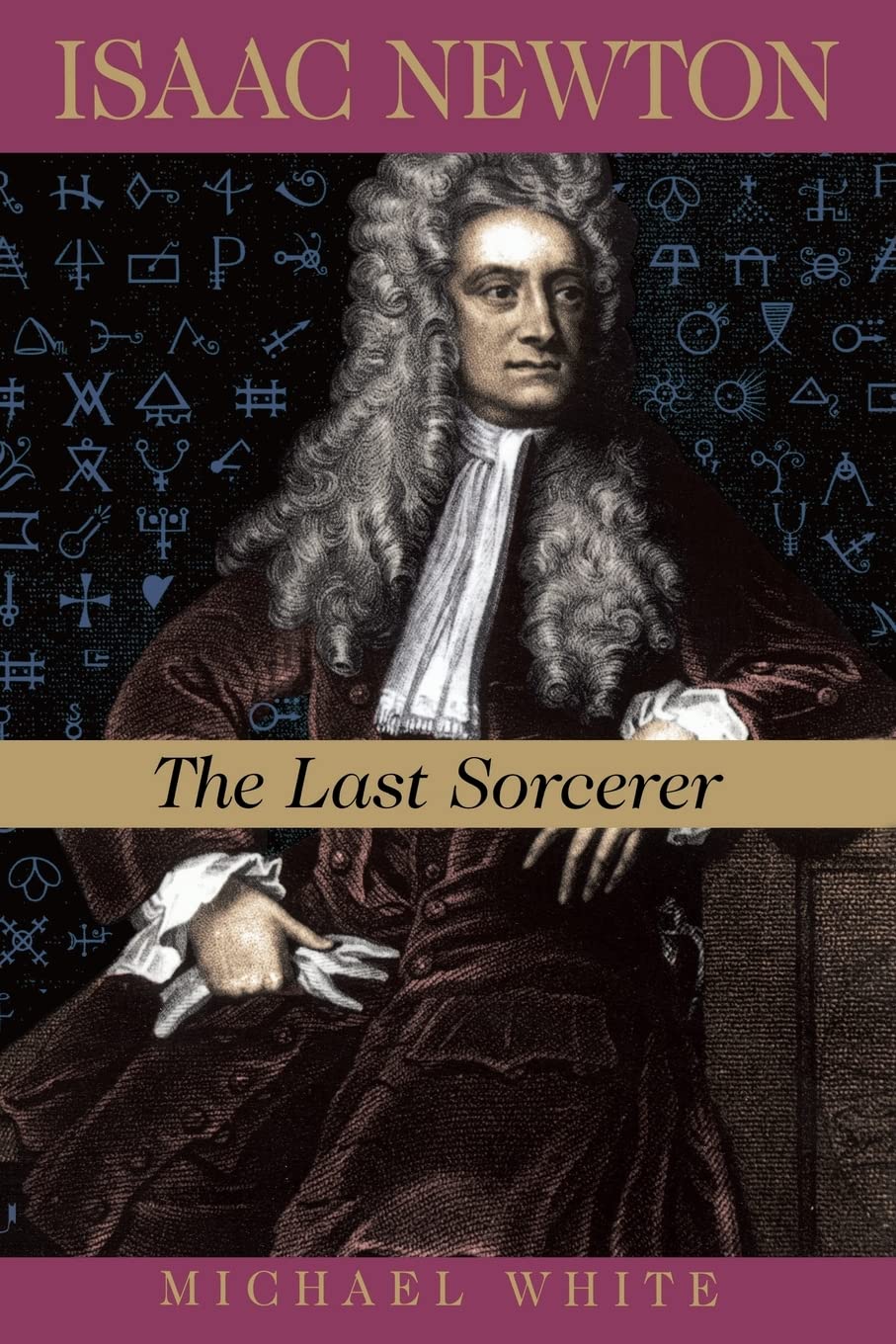
To glimpse Newton in full is to hold together both the shining edifice of his scientific achievements and the shadowy corridors of his hidden pursuits. This is precisely what Michael White, bestselling author of Isaac Newton: The Last Sorcerer, sets out to do. A former member of the British New Wave pop group Thompson Twins, White reinvented himself as a prolific writer, publishing 38 books across science, biography, and history. His biography of Newton reveals a thinker as enthralled by the mysteries of alchemy as by the certainties of mathematics, a man whose personal darkness was as striking as his intellectual light.
In this interview, White examines Newton's contradictions: his genius and his secrecy, his scientific triumphs and his more esoteric fascinations. By peeling back the layers of myth, he reveals a Newton who was not only the architect of modern science but also a deeply human figure, shaped by obsession, rivalry, and the restless search for ultimate truth.
Charles Carlini: How does a former member of one of the most successful bands of the early 1980s—The Thompson Twins—transform himself into a globally best-selling author with a predilection for writing popular science books on Galileo, Newton, Einstein, and Hawking? How and when did you reverse course?
Michael White: I’m often asked this question, and my pat answer is that it is not as extreme as going from a pop group to being Prime Minister of Britain as Tony Blair did.
The fact is, I always wanted to be a writer, and I was writing my earliest (unpublished) fiction while touring with the Thompson Twins. I became involved in music at school and played in various university groups at King’s College in London, where I studied chemistry. I had serious ambitions for what I would do after I left the band, but I changed course and started doing some popular science writing. I then became a lecturer and wrote when I could. The big break was writing the biography of Stephen Hawking with John Gribbin. When the royalties came through for that, I left teaching and have been a professional author ever since.
CC: In your critically acclaimed book, Isaac Newton: The Last Sorcerer, you deal very heavily with Newton’s interest in mysticism and the occult. What sort of impact did this have on his life?
MW: I would say it was a central feature of Newton’s life. As I say in the book, Newton held the conviction that all knowledge was relevant and open to exploration. He was, of course, aware that becoming involved with occult studies and practices such as alchemy was dangerous. If he had been exposed as a necromancer (a person who communicates with the spirits of the dead), it would have not only destroyed his career, but he may have faced execution as well. So obviously, he kept it a secret. However, during his lifetime, he wrote approximately a million words on alchemy, which is more than he wrote on science or mathematics.
CC: Newton frequently came under fire for supposedly opposing the Church, yet he was also said to have been a devout Christian in his own way. Given his occult interests, what would you say Newton’s religious leanings really were?
MW: He was a pious Christian, a puritan in fact. However, he saw no disparity in holding conventional, strict religious views whilst researching occult practices. He was driven by an overwhelming urge to learn and to understand how the universe worked. He saw it as his religious duty to do this. He believed he had been chosen to unravel the mechanism of how the universe worked by God. He considered himself a unique genius.
CC: Newton’s Philosophiæ Naturalis Principia Mathematica is considered one of the most important scientific texts ever written. What sort of impact did it have on his contemporaries? Or, as it employs very challenging mathematics, was it even understood?
MW: It was understood by his scientific contemporaries and discussed at great length at the Royal Society, where he was President. Some of his contemporaries contested some of Newton’s assertions. He had many powerful enemies, including John Flamsteed and Robert Hooke. Yet Newton’s ideas were seen immediately as a huge step forward, and the Principia was accepted as a great work that explained many aspects of how the universe operated and provided a mathematical foundation for ideas that had only been glimpsed before.
CC: The image of Newton being inspired to write his theory of gravity by an apple falling from a tree is a popular one. How accurate is this version of events? And what exactly was Newton's brainstorm regarding gravity?
MW: It is largely a myth that Newton created around himself. He was indeed at his mother’s house in Grantham in 1665 because Cambridge was in the grip of a terrible plague. There was a small orchard near the house, and ‘the tree’ is still there. He may well have sat under this tree thinking about gravity, but the idea of the apple falling is a cozy little story. In fact, Newton confessed to Voltaire late in life that he had made up the incident. He did this because it was a convenient cover story to deflect attention from the true inspiration behind his interpretation of universal gravitation—a combination of mathematics and alchemy. Practicing alchemy was a crime punishable by execution, so Newton had to do everything he could to allay suspicion.
CC: Aside from his universal law of gravitation, what other major contributions to science did Newton make?
MW: Newton elucidated the three laws of motion, which define mathematically how all things move in a non-relativistic universe. This work was tweaked by Einstein some two centuries after Newton’s death. These laws were stated in Newton’s first masterpiece, The Principia.
In his second great work, Opticks, Newton set forth a host of rules and laws that explain the behavior of light. He invented an incredibly sophisticated lens and the reflecting telescope.
As well as this, Newton developed a version of calculus, which was enormously important to him in his mathematical work on gravity, optical phenomena, and the laws of Mechanics.
CC: Who would you say were some of Newton’s most prominent influences?
MW: Newton was influenced more by ancient mystics and alchemists than by scientific contemporaries. He was a great admirer of Galileo’s work, which really laid the foundations for his own studies in both mechanics and optics. Around the age of fifteen or sixteen, he inherited a large library and studied it avidly. The library included the works of many great thinkers, such as Descartes, Galileo, Tycho, and Roger Bacon. These people played a major role in providing intellectual grounding.
CC: There remains some controversy about the relationship between Newton and Robert Hooke—some accuse Newton of using some of Hooke’s ideas without assigning due credit. Would you say there’s anything to these accusations?
MW: Newton was an abrasive, deeply unlikeable man, an obsessive who had no qualms when it came to gaining an intellectual foothold. He believed God chose him as a once-in-a-millennium conduit. He thought he had a direct link to God and was the divine mouthpiece. As a consequence, he would not turn away from any opportunity to take what he believed to be rightfully his. He saw Hooke as a second-rater. The same may be said for the way he felt about the Astronomer Royal, John Flamsteed, and most famously, Gottfried Wilhelm von Leibniz. So yes, I think there is every chance Newton stole from Hooke.
CC: Another controversy concerns the priority dispute with German mathematician and philosopher Gottfried Wilhelm von Leibniz over who rightfully invented the calculus. Can you describe the circumstances of this controversy?
MW: Newton claimed (erroneously) that Leibniz had stolen the idea of the calculus from him. In fact, what happened was that the two men had each independently arrived at the mathematical technique more or less simultaneously, and each had no idea what the other was working on. As I said before, Newton believed he was sent by God to interpret Nature. He believed he was in a league of his own and every other scientist or philosopher, living or dead, was inferior. He could not accept the idea that God would have shared the revelation of the calculus with another at the same time as it was revealed to him. Leibniz, he concluded, was a liar and a thief.
The fight lasted 35 years. Leibniz died before Newton, but Sir Isaac continued to attack his rival publicly even after Leibniz‘s death.
CC: Newton was reputed to have terrorized his underlings during his later years. What would you say his personality was like during this period?
MW: I think the answers above give some clues! He was a person greatly damaged by childhood trauma. He was a sociopathic egomaniac. He only ever had two friends—one was John Wickins, his roommate at Cambridge, the other was a much younger mathematician, Nicolas Fatio de Duillier, with whom he had an intense sexual relationship. As Newton grew older, he did not mellow. He became Master of the Royal Mint. He attended every execution of fraudsters and counterfeiters, even though it was not part of his job description, and he pushed through as many charges of high treason as he could (as opposed to mere treason). Treason meant hanging, but those found guilty of high treason were hanged, drawn, and quartered.
CC: What is Newton's legacy today? Why are we still interested in him 300 years later?
MW: Even though he was a very unpleasant human being, he was a great genius. He is rightly remembered as being the most influential scientist in history. His work laid the foundations for the Industrial Revolution, which led to our modern technological world. When the Apollo missions were sent to the moon, Newtonian mechanics was used to plot their courses. Lasers were developed thanks to Newton’s laws of optics. And although Leibniz’s form of the calculus is the system we use today, when Newton hit a wall trying to devise his laws of motion, he invented a technique with which to solve the problem—his version of the calculus.
But perhaps, above all else, and despite his corrosive personality, Newton was the model for the Age of Enlightenment, which started when he was elderly. He is really the embodiment of the pure scientist and mathematician, and a man who dedicated most of his life to learning and advancing understanding.
Recommended Reading
0 comments