

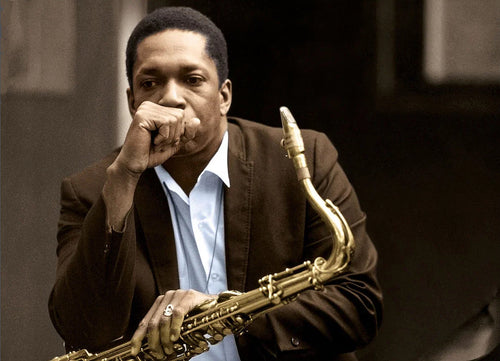
On the night of December 9, 1964, John Coltrane led his quartet into Rudy Van Gelder's recording studio in Englewood Cliffs, New Jersey, and recorded A Love Supreme in a single session lasting just a few hours. He had written the suite in one concentrated burst of inspiration after what he later described as a spiritual awakening, a moment in which, he said, he had experienced God directly and felt compelled to offer something in return. The album that emerged—four interconnected movements tracing a soul's journey from acknowledgment through resolution—would become one of the most celebrated recordings in the history of American music, and one of the most unusual: a jazz record that functioned simultaneously as a prayer, a confession, and a gift. Coltrane included a handwritten poem in the liner notes, addressed not to critics or listeners but to God himself. He was 38 years old. He had three years left to live, and he spent them pushing further into musical territory so extreme that even his most devoted followers sometimes couldn't follow. He seemed, in those final years, less like a musician playing jazz than a man trying to use sound to say something that sound alone could not contain.
John Coltrane (1926–1967) occupies a place in jazz history that is difficult to describe without reaching for language that feels almost religious, which is fitting, because Coltrane himself never drew a clean line between music and devotion. From his early mastery of bebop through the harmonic revolutions of Giant Steps, the sustained spiritual intensity of A Love Supreme, and the shattering freedom of Ascension, his career traced one of the most dramatic and uncompromising artistic trajectories of the 20th century. He did not merely expand the possibilities of jazz improvisation. He redefined what a musician could demand of himself, of his instrument, and of the people listening, treating each performance as if something genuinely at stake required resolving before he could stop playing.
What makes Coltrane so enduringly fascinating is the gap between the music's overwhelming emotional force and the almost scholarly rigor with which he constructed it. He was a tireless student, practicing scales for hours, studying music theory with obsessive dedication, and absorbing influences ranging from West African drumming to Indian classical music and European modernism. The sheets of sound for which he became famous were not spontaneous outpourings but the product of a mind that had internalized so much structure it could afford to appear to abandon it entirely. Behind the transcendence was an enormous amount of work, and behind the work was a man wrestling with questions about beauty, suffering, and meaning that his saxophone was the only instrument capable of asking.
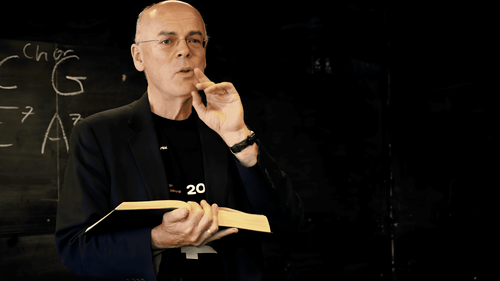
To explore both the music and the man behind it, we turn to Lewis Porter, one of the preeminent authorities on Coltrane's life and work. Holder of a Ph.D. in musicology and formerly a jazz professor at Rutgers University, Porter has devoted much of his scholarly career to illuminating Coltrane's genius through two highly regarded books and numerous articles that have shaped how musicians and listeners understand his legacy. He is also an accomplished pianist who has recorded across 37 albums alongside artists including Terri Lyne Carrington, John Patitucci, and Dave Liebman, bringing a performer's instinct to his scholarship. His widely read Playback newsletter, praised by Ted Gioia as the work of a bona fide expert and trusted authority, continues to enrich jazz discourse for readers across the world. In this interview, Porter reflects on Coltrane's relentless artistic evolution, the spiritual architecture of his greatest recordings, and why a musician who died at 40 remains one of the most vital and unfinished conversations in American music.
Charles Carlini: Your book, John Coltrane: His Life and Music, published in 2000, is widely regarded as the definitive biography of Coltrane. One critic praised it as “a triumphant labor of scholarship,” while another called it “the most reliable source of information on his music.” How much research went into your book before it was finally published?
Lewis Porter: Thank you. I had an epiphany one day in 1978 while listening to A Love Supreme for the umpteenth time. I decided then that I had to write about Coltrane’s music. Some years later, I decided to research his life as well. The book was published at the end of 1997. So I worked on it off and on for 19 years! Of course, I did many other things during those years as well, including raising two kids, completing other books, teaching music full-time, etc.
CC: And what do you think sets it apart from other Coltrane biographies?
LP: I’m reluctant to brag, so let me simply point out that I am the only Coltrane biographer, and one of the only jazz biographers, who is both a professional jazz performer (pianist) and a trained researcher (Ph.D. in music history). This background helps tremendously. By the way, your international readers will be interested to know that the book is available in French, Italian, and Russian translations. And I’m posting my current research on Coltrane—as well as Billie Holiday, Tatum, Monk, and many others—every week in my newsletter on Substack.
CC: One of the main reasons you cite for producing a new biography on Coltrane is the paucity of comprehensive and reliable ones. Why do you suppose that there haven’t been good biographies for such a towering jazz figure?
LP: It is rather peculiar that immediately following John Coltrane's passing in 1967, there were no biographies dedicated to his life. It wasn't until 1975 that the first two were published. However, this absence of reliable biographies extends beyond Coltrane and permeates the jazz realm at large. Fortunately, in recent years, we have witnessed the emergence of notable works such as Robin Kelley's insightful biography on Monk and Aidan Levy's comprehensive tome on Sonny Rollins. Yet, there still remains a plethora of hastily assembled books lacking thorough research and lacking a cohesive vision of effective organization.
CC: Jazz critic Ben Ratliff has said of Coltrane that “he is one of the five or so major figures of jazz whose playing you still routinely hear through the instruments of younger musicians; both in his sound and in his intellectual rigor, he was the next great saxophone icon after Charlie Parker.” Why do you think he has resonated with so many young players?
LP: By about 1960, he showed a way forward that no longer relied upon Charlie Parker. His playing was so rich that it opened up many avenues to explore. One could choose just one of Coltrane’s many innovations and explore it for a lifetime. And that’s exactly what many musicians did. And of course, his influence went far beyond saxophonists. But what especially is appealing about his music is that he functioned on the highest possible level with his whole being—intellectually, technically, and emotionally. It’s inspiring to all musicians.
CC: Your book delves into Coltrane's collaborations with other jazz legends such as Thelonious Monk and Miles Davis. How did these collaborations shape Coltrane's music, and what did he bring to these musical partnerships?
LP: Of course, that could be a book in itself. In brief, his interviews reveal that he highly respected both of them, but felt closer and safer with Monk personally. He once said that he felt he had to tiptoe around Miles because of his tendency to get angry. Nevertheless, it was Miles who encouraged him to go into modal music, which, of course, became a signature for him. And before that, it was Monk who allowed him to explore the very limits of the saxophone and of harmonic complexity, often without piano accompaniment behind him.
CC: One of the many fascinating details uncovered in your book is how Coltrane appropriated ideas from existing works for some of his compositions. For example, one of his best-known compositions Impressions was directly lifted from a Morton Gould composition entitled Pavanne. This is impressive detective work on your part. How did you stumble upon this little-known aspect of Coltrane’s music? And can you cite other examples of his compositions that are taken directly from others?
LP: One thing about research is that you cannot do it on a schedule. You never know when you're going to discover something. In the case of “Impressions,” I have to say that that was out there in the air. There were musicians who knew about the Morton Gould connection. But I recently discovered that Coltrane got the title for “Impressions” from Erroll Garner, which nobody knew before. There are many more examples like this in my newsletter at Substack, including the origins of “Spiritual” and “Big Nick.” Soon I’ll be posting about the origins of “India” and “Ogunde.” I'm currently looking for the source of his piece “Africa,” so wish me luck on that one!
CC: One of Coltrane’s landmark recordings was his 1960 album entitled Giant Steps. The album exemplifies Coltrane’s signature “sheets of sound” and penchant for chromatic third relations. Can you elaborate on these two devices found in his music?
LP: Jazz critic Ira Gitler was also an amateur saxophonist, and he coined the expression “sheets of sound” simply to refer to long, flowing lines up and down the saxophone made up of 16ths or even faster notes. The interesting thing is that Coltrane not only accepted this phrase—unlike most musicians who reject things that critics say—but he came up with his own meaning for it. He wrote in 1960 that he did not think it applied to all fast runs, but only runs that suggested a variety of tonal centers very quickly, one after the other.
Given that, you would think that both Gitler and Coltrane would have applied it to the title piece of “Giant Steps,” since the whole point of that song was to move through a lot of tonal centers very quickly. But because Coltrane solos on it almost entirely in eighth notes, neither he nor Gitler considered that to be an example of sheets of sound. Coltrane used sheets of sound more during the year 1958 than at any other time in his life.
CC: The album that brought Coltrane widespread fame was his 1961 release entitled My Favorite Things. It was the first time he was featured playing the soprano saxophone. How did this change in instrumentation affect his sound and style, and what impact did it have on his career moving forward?
LP: Coltrane said in a 1966 interview that he was well aware that he played differently on soprano. Whereas the tenor saxophone was what he called "the power horn,” on the soprano, he tended to play, appropriately, sprightly and with winding lines. It has not been noted that when he began his contract with Impulse Records, they explicitly pressured him to come up with another soprano saxophone hit like “My Favorite Things.” It never happened, but when A Love Supreme became a far bigger hit, they realized that you just can't plan or manufacture that type of success.
CC: In your book, you examine the spiritual and philosophical influences on Coltrane's music, particularly his later works such as A Love Supreme. How did these influences shape his music, and how did they reflect his personal beliefs and experiences?
LP: It is probably not fair to try to answer this in a paragraph. But I will say that beginning around 1957, Coltrane was interested in getting out of his strictly Christian upbringing and exploring all possible spiritual beliefs and practices. A Love Supreme was very explicitly non-denominational, and without a doubt, that's the direction that Coltrane was moving in toward the end of his life. As far as how that is reflected in his music, he had a very particular sense of what spiritual music sounded like—a slow introduction, modal open-ended structures, vamps, and chant-like melodies. In my Substack newsletter, I posted an essay on his spirituality with the provocative title, “Coltrane did not want to be a saint.”
CC: Coltrane's music often pushed the boundaries of traditional jazz structures and forms. How did he innovate and experiment with the conventions of jazz, and what impact did this have on the genre as a whole? In your opinion, what is Coltrane's most significant contribution to jazz music, and why do you think his music continues to resonate with audiences today?
LP: As far as his contribution musically, he showed by his own work, that is, by doing, that an open mind and an interest in everything can contribute to one’s musical art. We jazz musicians do not have to be bound by the idea that we can only draw upon the “jazz tradition.” Anything and everything can be incorporated into this musical art.
Beyond that, he persuasively and successfully made the case that pursuing one’s goals as a jazz performer is just as meaningful as any other artistic endeavor. He helped to get rid of the idea that it was a pursuit only fit for dingy nightclubs and that it had to be accompanied by a sort of questionable lifestyle. He famously “cleaned up his act.” In this, he had a positive impact not only on the musicians and their attitude towards what they were doing, but to the whole attitude of society towards jazz and jazz artists.
Recommended Reading

0 comments