

He made love and conscience sound inseparable, and in doing so turned a novel into a political crime.
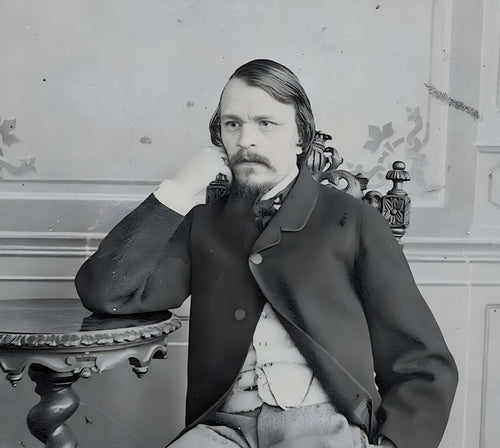
Boris Pasternak never set out to be a dissident. He was born in 1890 into a cultivated Moscow family, surrounded by painters, musicians, and writers; Leo Tolstoy and Sergei Rachmaninoff were visitors to his parents’ home. He began as a poet, not a novelist, shaping dense, lyrical verse rather than manifestos. Yet the book that would define his life, Doctor Zhivago, forced him into a role he had not sought: the writer whose attempt to describe the Russian Revolution from the inside, with sympathy but without slogans, became intolerable to the state that claimed to embody its meaning.
His achievement was not formal experimentation so much as moral stubbornness. Pasternak insisted that history had to be told as lived experience—messy, divided, filled with betrayals both intimate and political—rather than as tidy legend. That insistence was enough to turn him, in the eyes of Soviet authorities, from ornament to threat.
A Poet in the Revolution’s Shadow
Pasternak’s early life followed the arc of the Russian intelligentsia through upheaval. He lived through the First World War, the 1917 revolutions, and the civil war that followed. Unlike many contemporaries, he did not emigrate after the Bolsheviks took power. He stayed, writing poems that gradually shifted from avant-garde abstraction toward a more direct, spiritual attention to everyday life.
The new regime was never entirely sure what to do with him. He was admired, tolerated, sometimes criticized, but not immediately crushed. He joined no party, signed no ringing declarations, and avoided direct political commentary. His poetry, with its dense imagery and emphasis on individual perception, did not fit neatly into the optimistic, didactic mold that Soviet cultural policy increasingly demanded. Still, for a time, a space existed in which a “difficult” lyric poet could survive by keeping his head down. Pasternak used that space to think about a different, more dangerous project.
Making a Life into a Lens
Doctor Zhivago was that project. Worked on for years and completed in the 1950s, the novel followed Yuri Zhivago—a doctor and poet—through revolution, war, and personal entanglements, tracing how large events tear through private lives. The book did not denounce the revolution outright, but neither did it glorify it. It showed enthusiasm curdling into fear, lofty ideals colliding with cruelty and bureaucracy, and ordinary people trying to salvage decency as history lumbered over them.
The politics are never separated from the personal. Zhivago’s love for Lara, his sense of vocation as a doctor, and his inner life as a poet are all caught in the same storm that redraws borders and rewrites loyalties. For Pasternak, this interweaving was the point: history is not an abstract force but something that arrives as hunger, cold, separation, compromise, and the quiet heroism of those who refuse to surrender their inner freedom.
Censors saw something else. They saw a refusal to present the revolution as necessary and righteous, and a clear-eyed depiction of party functionaries and secret police as petty, sometimes brutal, often blind. It was enough to ensure that the book would never be published in the Soviet Union in his lifetime.
Smuggled Pages, Global Scandal
When Soviet publishers rejected Doctor Zhivago, Pasternak took the risk of letting the manuscript go abroad. An Italian publisher brought out the first edition in 1957; translations followed, and the book quickly became an international sensation. Western readers embraced it as a human-scale account of life under totalizing ideology. Western governments, especially during the Cold War, saw propaganda value in a Russian novel that the Soviet Union had suppressed.
The result was a storm that Pasternak could not control. In 1958, he was awarded the Nobel Prize in Literature, officially for his poetry but in reality because of the novel that had just shaken the Soviet cultural world. The Kremlin treated this not as an honor for Russian letters, but as a political provocation. State-controlled media denounced him; colleagues were pressured to sign letters condemning him; he was expelled from the writers’ union and faced possible exile if he accepted the award.
He declined the prize in a now-famous telegram, citing the hostile reaction at home. The gesture did not erase the humiliation, either for him or for the regime. Pasternak found himself both celebrated abroad and isolated in the country whose soul he had tried to portray with such care.
An Inner Emigration
In his later years, Pasternak lived under a kind of internal house arrest of reputation. He was not imprisoned, but he was watched; his works were restricted; his name became taboo in official cultural life. Friends and visitors recalled a man who had become wary and tired, yet still spoke of literature as a form of conscience.
He returned, as much as he could, to poetry and translation. His Russian versions of Shakespeare and other classics brought him some measure of official usefulness, allowing him to continue working, if not on the terms he might have wished. His health declined, and he died in 1960, with crowds attending his funeral despite efforts to downplay it. The novel that had upended his life would not be published legally in the Soviet Union until the late 1980s.
The Double Life of a Novel
Doctor Zhivago went on to live two lives: one as a banned book circulating in samizdat among Soviet readers hungry for an unsanctioned account of their own history, and another as an international best-seller adapted into a sweeping film that turned its love story into global cinema. The tension between those versions—intimate moral drama versus grand romantic spectacle—mirrors the tension in Pasternak’s own reputation.
Outside Russia, he was often cast as a heroic dissident, a solitary conscience standing against tyranny. Inside, especially for those who knew the compromises and silences of Soviet literary life, the picture was more complicated: a gifted poet who hesitated, wavered, and suffered under pressure, yet still managed to smuggle out one book that refused to lie. The ambiguity does not diminish his achievement; it humanizes it.
The Enduring Enigma
Boris Pasternak’s legacy does not rest only on Doctor Zhivago, but the novel remains the clearest lens on what he tried to do. He wanted to show that private decency and inner truth mattered, even when history seemed determined to crush them, and that love—romantic, familial, spiritual—could not be reduced to ideology. He did this not through thesis but through scenes: a crowded train, a field hospital, a snowbound house where poetry is written as the world falls apart.
What makes Pasternak enduring is the way he kept the full complexity of experience in view. He refused to simplify either the revolution or its victims, and he refused to turn his characters into mere symbols of innocence or guilt. In a system that demanded clarity—friend or enemy, loyal or traitor—he insisted on ambiguity, on mixed motives, on the stubborn individuality of lives lived under pressure.
Boris Pasternak did not set out to be a political symbol. He wanted, first, to be a poet of the inner life. History had other plans. The writer who tried to give one country an honest novel about itself ended up reminding readers everywhere that the price of telling the truth is often paid not in slogans, but in the slow erosion of a life—and that some stories are worth that cost.
Recommended Reading


0 comments