

On the morning of October 4, 1903, a twenty-three-year-old Viennese philosopher named Otto Weininger rented a room in the house in Vienna's Schwarzspanierstrasse where Ludwig van Beethoven had died, and shot himself through the heart. He had published his only book, Sex and Character, five months earlier, a sprawling, brilliant, and deeply troubling work that had received modest attention at the time. His suicide changed everything. Within weeks, the book was a sensation, passing through edition after edition and generating a cultural reaction that spread far beyond Vienna. Strindberg praised it. Wittgenstein kept a copy for the rest of his life and recommended it to friends, even as he acknowledged its fundamental errors. Freud dismissed it. Kraus admired it. And in the decades that followed, the work was taken up by forces that Weininger, for all the darkness of his thinking, could not have anticipated: appropriated by anti-Semites despite, or perhaps because of, the fact that its author was himself Jewish and had converted to Christianity on the day of its publication, weaponized by ideologues who extracted its most extreme passages and discarded the philosophical context in which they had been embedded. Hitler reportedly kept a copy. The young man who had sought Beethoven's death room as the appropriate setting for his exit had, in dying, handed his ideas to people who would do things with them he had never imagined.
Few figures in modern intellectual history provoke as much fascination and unease as Otto Weininger. He was hailed as a prodigy, dismissed as a fraud, embraced by fascists, and shunned by liberals. His name lingers like a specter at the margins of philosophy, more often invoked as scandal than substance. Yet the man behind the legend remains elusive: a young thinker whose life ended at twenty-three, but whose ideas, however flawed or distorted, refused to die.
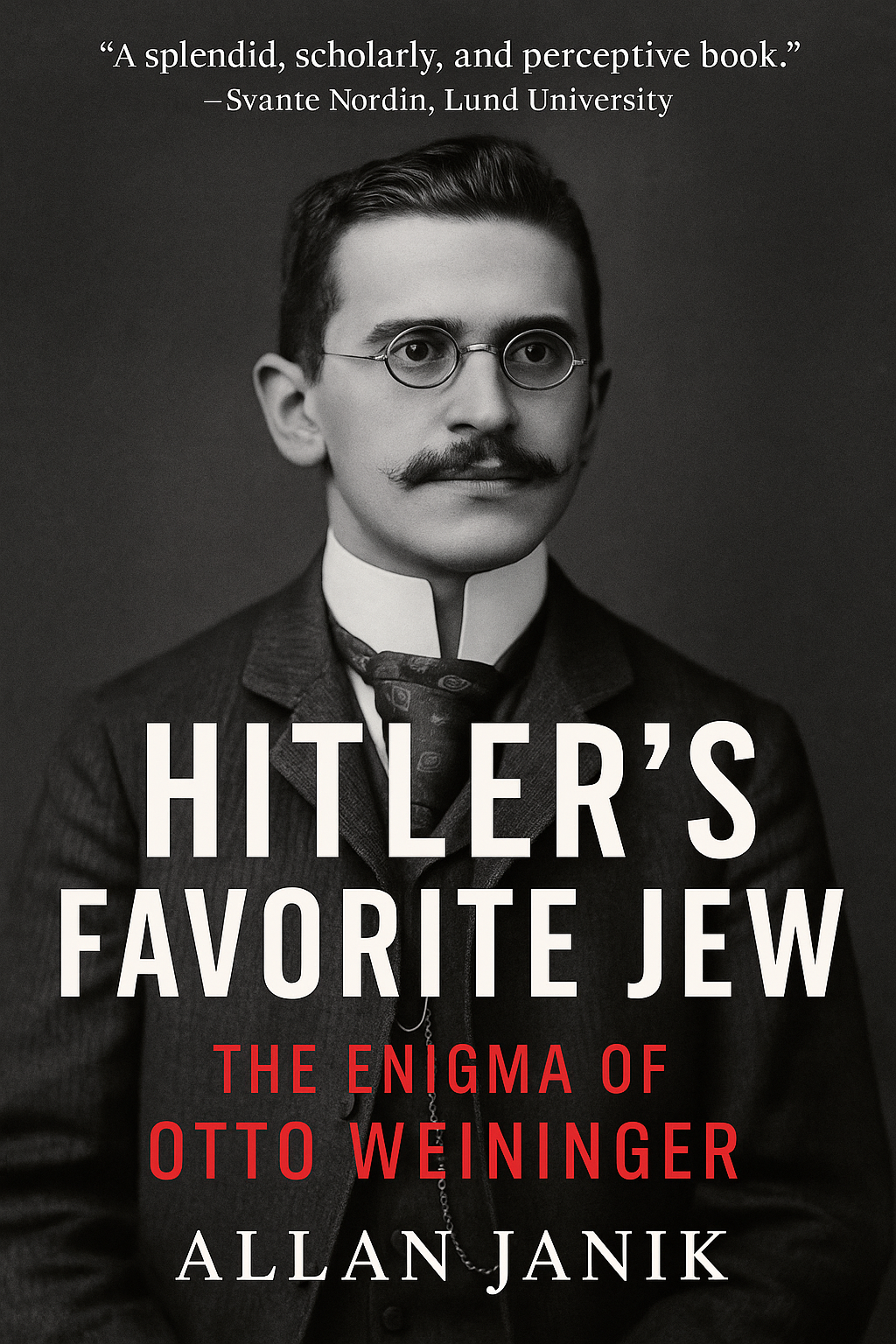
In Hitler's Favorite Jew: The Enigma of Otto Weininger, philosopher and historian Allan Janik dismantles the sensationalist legacy that has clung to Weininger for over a century. Drawing on decades of archival research and grounded in the intellectual traditions of the Vienna Circle and Stephen Toulmin's school of philosophy of science, Janik offers a rigorous recontextualization of a life and a body of thought that have almost never been examined on their own terms. This is not a redemption narrative, nor an apology. It is a study in intellectual history: a careful attempt to understand how a troubled young thinker, shaped by the philosophical, scientific, and cultural assumptions of fin-de-siècle Vienna, crafted ideas that would later be appropriated by forces he could neither have anticipated nor have endorsed.
In the conversation that follows, Janik guides us through the intellectual world that formed Weininger, exploring how his work became a lightning rod for controversy, why early scholars feared contamination by association, and what restoring him to his proper historical context might teach us about the dangers of decontextualized thinking in our own time. The discussion resists easy answers and embraces necessary complexity, because understanding Weininger is not a matter of choosing between genius and madness, but of asking how fragile ideas become freighted with consequences their authors never foresaw, and what we owe to honest examination of the most uncomfortable corners of intellectual history.
Charles Carlini: What first drew you to Otto Weininger, and what made you stay with him, even when most scholars chose to steer clear?
Allan Janik: When I first met G.H. von Wright, Ludwig Wittgenstein’s literary executor, I had just published my first work on Wittgenstein, an attempt to trace the overlap between the early texts of Wittgenstein and the philosophy of Arthur Schopenhauer. To my delight, Prof. von Wright told me this was a fruitful approach to Wittgenstein’s thought. He went further, noting that my work touched on themes in Wittgenstein rooted in Vienna 1900, particularly his admiration for the eccentric polymath Otto Weininger. He even brought up a deeply obscure text, on the psychology of the criminal, buried in Weininger’s little-read posthumous papers, published as Last Things.
That marked the beginning of Wittgenstein’s Vienna. And so the adventure began. I immersed myself in Weininger’s work, refusing to surface until I had grasped his influence on Wittgenstein. It never crossed my mind that this pursuit would eventually lead me to produce a critical edition of Weininger’s writings. And regardless of my personal feelings about Weininger and his ideas, my scholarly duty demanded that I engage with his work fairly, giving him the benefit of the doubt at every turn.
CC: Before serious scholarship emerged, Weininger was mostly known for a handful of dramatic facts: his controversial book, his suicide at 23, and his disturbing appeal to figures like Hitler. How much of that early image was accurate?
AJ: Beyond a few stark facts—that he had taken his own life on that October night in 1903, barely five months after publishing Sex and Character—we knew almost nothing. The circumstances of his suicide remained shrouded in mystery, save for the often exaggerated significance of its location: the very house where Beethoven died. Thus began the machinery of mythmaking.
Weininger's close associates offered contradictory accounts of his final hours: one insisted he had been perfectly composed, another described him as profoundly agitated. These conflicting reports fueled endless speculation, quickly dividing observers into opposing camps. Yet among his professional peers, the reaction was unanimous: shock and sorrow that such a brilliant young mind, one so full of intellectual passion and vitality, could have surrendered to despair's final embrace.
CC: You’ve spent years re-contextualizing Weininger’s life and work against a backdrop of limited and often misleading biographical evidence. What was the turning point that made rigorous study of him not only possible, but necessary?
AJ: Weininger scholarship had modest beginnings with the first serious effort to document his fragmentary writings. These included materials he had deposited at the Austrian Academy of Sciences to protect the priority of his discoveries, along with a collection of letters from the Austrian National Library. The landmark work was Eros and Psyche, published in 1990 by Hannelore Rodlauer, a scholar of considerable standing who had previously edited handwritten texts from Franz Kafka's posthumous papers for Sir Malcolm Pasley's critical edition.
Rodlauer's meticulous documentation revealed a crucial fact: the seventeen-year-old Weininger had gained admission to Vienna's most exclusive intellectual circle, the Vienna University Philosophical Society. This elite group comprised the crème de la crème of Viennese intellectuals—philosophers, scientists, medical experts, budding psychoanalysts, and cultural critics. Membership required passing a rigorous qualifying examination.
The Society's Proceedings published an obituary that completely contradicted the prevailing image of Weininger as an isolated, suicidal fanatic. Instead, it portrayed a vital, engaged thinker who participated in the Society's discussions with both intellectual rigor and remarkable energy. His dynamism left a profound impression on fellow members. Here, for the first time, were documented facts that challenged the myths surrounding Weininger's legacy.
CC: Why do you think so many people have tried to label Weininger as either a misunderstood genius or completely insane? What do we lose by thinking in such extremes?
AJ: The temptation to oversimplify Weininger's case remains inseparable from the vehemence of Viennese cultural polemics, a tendency still faintly visible in the City of Dreams. Weininger's striking manner of expression and his precocious brilliance stood out particularly in what was essentially a gerontocratic society. Consider that in Vienna's upper middle class, where men did not reach legal majority until 25, it remained nearly impossible for anyone under 30 to marry or establish a family. Against this backdrop, Weininger's youthful achievements stood in stark relief.
The lavish praise from established intellectuals might easily convince ordinary observers that they were witnessing a genius at work. Yet the extremity of his anti-Semitic pronouncements and his writings about women's supposed immorality and irrationality equally suggested a mind unhinged. We must remember this was an era that accepted the bell-curve distribution of intelligence as scientific gospel, an age that saw extraordinary brilliance and complete social deviance as equally rare yet fundamentally connected extremes.
The fundamental error here lies in substituting crude categorization for proper historical-biographical analysis. Such an approach inevitably tears individuals from their context, systematically rendering true understanding impossible. When we force Weininger into the ready-made boxes of "genius" or "madman," we lose sight of the complex reality that was both the man and his intellectual world.
CC: Was Weininger a self-hating Jew, as some have claimed, or something more complicated? You’ve criticized that label in the past. What’s wrong with it, and how should we understand his Jewish identity instead?
AJ: Despite his diatribe against conventional Jews, Weininger was not a so-called self-hating Jew. The true self-hater tries to hide or erase their Jewishness; Weininger, by contrast, deliberately identified himself as a Jew even amid his fierce critique of Judaism. He insisted that what troubled him was not Judaism as a racial or social identity, but as an attitude—a mode of being. Admittedly, his qualification that this attitude was most commonly found among those of Jewish background muddies the waters more than it clarifies them. Still, he was a self-critical Jew, not a self-hating one.
Was Weininger a misunderstood genius? Is anyone, really, a genius? It's not a term that holds much weight in scholarly discourse. Rather, it's a label the media likes to throw around when praising dazzling innovations, especially in the arts. That’s usually where we find the term in its natural habitat.
So how do we reconcile Weininger’s undeniable brilliance with the toxicity of his legacy? The answer demands a nuanced and far-reaching explanation. First, we have to specify which of his ideas we’re referring to. The brilliance of Weininger lies in a book whose intricate, often convoluted argument was beyond the grasp of most of its readers, even those who tried to follow it, which many did not. Instead, attention fixated on the book’s most sensational elements: its anti-Semitism and anti-feminism. But these two strands occupy very different positions within his work.
His critique of feminism is central, woven throughout a multi-dimensional and theoretically ambitious analysis. His denunciation of Judaism, by contrast, appears in a chapter that could easily have been an afterthought, added hastily to a nearly complete manuscript. That, at least, is the view of Sigurd Paul Scheichl, Austria’s foremost authority on the rhetoric of anti-Semitism, who sees clear signs of stylistic haste in that chapter.
What emerged from all this was not one coherent legacy but a series of cliché-driven media spectacles. These polemics, far more than Weininger’s actual texts, shaped the public image of him that persists today. To be sure, both sides in the bitter cultural battles that roiled Vienna, and Austria more broadly, in the early 20th century appealed to Weininger’s verba ipsissima. But we must be cautious. For all his rhetorical extremism, Weininger’s writing on Judaism lacks any trace of racial hatred. And this matters.
It is all too easy to forget that anti-Semitism cannot be reasonably discussed without first identifying it as a species of racism. And by “racism,” we mean invocations of tropes like “Christ-killers,” “ritual murderers,” “blood suckers,” “extortionists,” or coded references like “Shylock” or “the international Jewish conspiracy.” These are absent in Weininger. He names no specific individuals or families, not even the Rothschilds. His virulent critique of Judaism, for all its passion, is entirely devoid of racist fanaticism. This is because, in his eyes, Judaism is a way of being that can be altered, what Pascal might have called a “change of heart.” Biology and religion are irrelevant to the picture he paints.
Weininger’s alleged antifeminism is a different matter altogether. His harsh remarks about women are embedded in a highly elaborate, ultimately misguided theory about intelligence and its physiological underpinnings. To modern readers, these ideas are not only scientifically obsolete but often downright laughable, akin to flat-earth theories in their disconnect from current knowledge.
And yet, Weininger’s aim wasn’t mere misogyny. Like Charlotte Perkins Gilman, ironically, one of his earliest American critics, he was trying, however clumsily, to dismantle the 19th-century ideal of Woman as “The Angel in the House.” He wanted to use the science of his time (however flawed) to argue that granting women the vote would harm both society and women themselves, transforming them, he claimed, into morally mediocre men.
Paradoxically, his views weren’t entirely out of step with certain strains of upper-middle-class feminism (as opposed to socialist feminism), which prioritized social and intellectual emancipation over political equality. Moreover, Weininger, in his own idiosyncratic way, was following Freud’s footsteps, attempting to posit a distinct form of female sexuality fundamentally different from the male version.
But this entire structure rested on dated scientific speculations. He believed human heredity, including sexual variation, could be reduced to a single explanatory principle. In reality, it would take decades of scientific work, the discovery of genes, and the formulation of heredity laws, for biology to even begin addressing these questions meaningfully. Weininger had no inkling of the scientific revolutions that would unfold shortly after his death.
Yet none of this complexity interested those staking positions for or against him on “The Woman Question.” What they cared about were the raisins in the cake: cherry-picking lines about emancipation or the supposed irrationality of women. Both his critics and defenders ripped clichés out of arguments meant to deconstruct clichés. In the process, the historical Weininger disappeared in the shuffle.
CC: His book Sex and Character caused an immediate stir; some hailed it as groundbreaking, others condemned it as hateful. Why do you think that book, in particular, became a kind of perverse “bible” for figures like Hitler?
AJ: Hitler was notoriously hostile to philosophy, and whatever admiration he expressed for Otto Weininger was filtered through the influence of his Bavarian “mentor,” Dietrich Eckart. Eckart, for his part, was the very picture of a crackpot intellectual, though a successful one. A prolific writer of drivel and a habitual drunk, Eckart was one of the very few people with whom Hitler is known to have formed a genuine bond.
Eckart’s reputation, aside from his prominent role among German nationalist fanatics in Munich, stemmed in part from his adaptation of Henrik Ibsen’s Peer Gynt. That adaptation was, in turn, loosely based on Weininger’s long essay On Henrik Ibsen and His Poem “Peer Gynt” (On the Occasion of the Poet’s 75th Birthday). But where Ibsen’s original work offered a critique of egoism and a vision of redemption from its destructive consequences, Eckart twisted the message beyond recognition, infusing it with German nationalist fervor, racial hatred, and crude anti-Semitism. In doing so, he not only mangled Ibsen’s intent but also grossly distorted Weininger’s interpretation of it, reducing both to grotesque caricatures.
In the ideological ferment of Wilhelmine Germany, this bastardized version of Ibsen, filtered through Eckart and falsely attributed to Weininger, was widely embraced. Eckart claimed that his reading of Peer Gynt drew from Weininger and took Weininger’s suicide as proof of his supposed realization that Jews were intrinsically evil and must be annihilated.
In truth, Hitler’s regard for Weininger had little to do with the content of Weininger’s writings, which he almost certainly never read. What he admired, under Eckart’s spell, was not Weininger’s philosophical complexity but what he took to be the “suicidal consistency” of a Jew who, in the Nazi imagination, affirmed the righteousness of his own destruction.
CC: You’ve described Weininger, with bitter irony, as “Hitler’s favorite Jew.” Was his appeal to the Nazis merely about self-loathing, or was there something more philosophically seductive in his work?
AJ: Weininger’s appeal to the Nazis, such as it was, had little to do with his philosophical thought. What resonated with them was not the complexity of his ideas but the perceived consistency of his actions. His suicide, as they interpreted it, embodied the Nazi ideal of self-annihilating idealism: the notion that one should follow a belief to its most extreme, even fatal, conclusion.
Hitler himself often proclaimed that Germany would either rule the world or perish in the attempt. That binary logic—dominate or die—was central to his worldview and, ultimately, the model for his own life and death. In that sense, Weininger’s suicide provided a kind of symbolic precedent.
Still, it’s doubtful how far this interpretation extended beyond the inner circles of Nazi leadership. For the average party loyalist, such philosophical justifications likely held little sway.
CC: Weininger’s early suicide casts a long shadow over his legacy. Do you think it amplified his influence, freezing him in time as a tragic genius, or did it cut short the possibility of him outgrowing his more extreme positions?
AJ: Weininger’s suicide became the nucleus around which wild speculations about his being either a genius or a madman began to swirl. And “wild” is the right word, because in truth, we know remarkably little about the circumstances with any certainty.
To make matters murkier, the friends who saw him on that fateful day in October 1903 gave conflicting reports about his state of mind. One recalled him as unusually cheerful; another claimed he seemed deeply despondent. The ambiguity leaves room for endless projection.
What we do know is that his university mentor, Friedrich Jodl, had seen great promise in Weininger. Jodl would not have been surprised had his former student gone on to produce a brilliant work, though likely one of a very different kind than Sex and Character.
CC: Wittgenstein admired Weininger, even though their philosophies diverged sharply. What do you make of that intellectual kinship, and how does it complicate Weininger’s reception among serious philosophers?
AJ: The question of Wittgenstein’s relationship to Weininger is enormously complicated by a central feature of Wittgenstein’s intellectual temperament: he was not especially drawn to true ideas. What interested him more were thoughts that seemed utterly strange, ideas that provoked, disturbed, or unsettled, which he then used as raw material for philosophical reflection.
Consider his response to German logician Gottlob Frege. What fascinated Wittgenstein was not merely the correctness of Frege’s logic, but the fact that he could develop it without relying on ordinary language. The entire Begriffsschrift doesn’t say what Frege aimed to demonstrate; it shows it. That kind of formal clarity, bypassing conventional expression, offered Wittgenstein a powerful model for how to think.
Weininger’s work played a similar role. Certain of his notions, such as the idealized, self-destructive nature of criminal existence, entered Wittgenstein’s philosophical imagination. Not because he agreed with them, but because they challenged him to think more deeply.
Wittgenstein’s admiration for Weininger, then, should not be mistaken for philosophical endorsement. It reflected a fascination with the strange and suggestive, not a shared worldview.
CC: You’ve said that understanding Weininger requires asking not just what he believed, but why he believed it—what shaped his views, and where those ideas came from. Can you help us understand the intellectual and cultural atmosphere of fin-de-siècle Vienna that formed him?
AJ: We might fairly characterize our current era as the age of the super-athlete. Today's cultural heroes pursue athletic competition with an intensity, duration, and consistency that surpasses ordinary comprehension. This stood in stark contrast to Weininger's Vienna, where cultural heroes were typically super-intellectuals. The entire aura surrounding the Philosophical Society reflects this reality, as does the exceptional quality of education at all levels.
What was it like to belong to such circles? Consider Stefan Zweig, another remarkably gifted young man of Weininger's age who gained admission to the Philosophical Society. Yet in his own estimation, Zweig, writing some fifteen years later, considered himself intellectually inferior to Weininger. He recalled being fascinated by Weininger and desperately wanting to meet him, yet finding himself unable even to speak to the disheveled figure sitting at the next café table. Such was the awe inspired by pure intellectual brilliance.
My German professor in college had attended a Berlin Gymnasium (those elite secondary schools preparing students for university) during the 1920s, when these values still prevailed. Bemoaning our contemporary lack of respect for gifted scholars, he described how the Primus, the top student in the class, commanded universal respect: we would hold doors for him or surrender our seats if necessary. These were the values of Vienna's middle class, with its substantial Jewish contingent, during Weininger's time, a rigorously disciplined society that produced scientists, philosophers, and artists. Nearly all chafed against this regimentation while simultaneously benefiting from it enormously.
Little wonder that until recently, we could still find 90-year-old Nobel laureates who had begun their scientific education in Viennese Gymnasiums. This educational culture remains one of fin de siècle Vienna's most defining and enduring features.
CC: Weininger’s ideas on gender were radical even for his time. Was he a product of the neuroses of turn-of-the-century Vienna, or was he uniquely unhinged in his thinking?
AJ: When it came to gender, Weininger, like Charlotte Perkins Gilman, was determined to dismantle the myth of woman as “The Angel in the House.” Just as Freud shattered the illusion of the Innocent Child, Weininger sought to use every scientific tool available to him to debunk the fantasy of the Innocent Woman. It’s no surprise, then, that his work caught the attention of thinkers like Gilman in the United States and the formidable Rosa Mayreder in Vienna.
This effort, despite popular caricatures, has little to do with Viennese neuroses or unhinged thinking. That label is often applied by those unfamiliar with the intellectual context in which Weininger operated, and with the remarkable esteem in which he was held by many of his contemporaries, including some of the finest minds of his era, in Vienna and beyond.
CC: If he had lived longer, do you think Weininger might have revised or renounced some of his more damaging ideas, or would he have doubled down? Is it even possible to separate the man from the myth that grew after his death?
AJ: Much of what we now associate with the name “Weininger” is, in fact, a myth, one that took shape through decades of controversy and distortion. It’s fascinating to contrast that myth with the image of Weininger that emerged immediately after the publication of Sex and Character, especially in responses from the medical community and even Jewish organizations.
What’s most striking about those early reactions is their emphasis on Weininger’s advocacy of sexual abstinence, offered as a solution to Tolstoy’s dilemma in The Kreutzer Sonata—the problem of the violently jealous, murderous husband. Equally surprising is how many commentators at the time saw Sex and Character as a deeply Jewish work.
We should be asking why these particular readings were considered central at the time. What cultural concerns or interpretive frameworks made them seem so immediately relevant?
CC: Your work challenges the simplistic reading of Weininger as just a proto-fascist crank. What’s the most misunderstood aspect of his philosophy that you wish more readers would grapple with seriously?
AJ: The most misunderstood aspect of Weininger’s thought is the tendency to conflate his cultural critique of Judaism with the Nazi ideology of Blut und Boden (Blood and Soil). While there may be superficial points of overlap, the two are fundamentally distinct.
In Sex and Character, Weininger explicitly rejects the idea that “Judaism,” as he uses the term, is a matter of race or religion. As a Kantian idealist, he understood Judaism not as an inherited identity but as a particular ego-centric disposition that could be overcome through an act of will. It was, in his view, a psychological or ethical attitude, not a biological destiny.
This is a crucial difference. Weininger’s account has nothing to do with immutable facts of nature, which were central to Nazi racial ideology. His critique is rooted in philosophy, not pseudoscientific determinism.
And incidentally, terms like “proto-Fascist,” much like “genius,” have no real place in the vocabulary of serious scholarship. They obscure more than they reveal.
CC: You’ve spent years combing through Weininger’s life, letters, and reception. What’s the most surprising or unsettling thing you discovered about him that isn’t widely known?
AJ: The most surprising, and in some ways, unsettling, revelation to emerge from my research was discovering just how deeply James Joyce was influenced by Weininger in writing Ulysses. Specifically, the idea that Leopold Bloom is a literary development of Weininger’s concept of the “feminine man” opened a new and unexpected window into Joyce’s imagination.
A second, no less startling, moment came when I found that Hans Kelsen, modern Austria’s most distinguished constitutional theorist, once said, at the age of seventy and from far away in California, that the only true genius he had ever known personally was Otto Weininger. Sadly, we have no further details on what prompted that judgment.
And that silence, too, is telling.
CC: For someone encountering Weininger for the first time today, why should they care? What does studying him help us understand about how dangerous ideas are born, spread, and endure?
AJ: Much of this may seem irrelevant to modern readers encountering Weininger for the first time, yet the stereotypes surrounding him prove nearly inescapable. By tracing how Weininger has been parodied and caricatured, then contrasting these distortions with the actual genesis and development of his ideas, we see a striking example of media polemics divorcing themselves from historical reality. The symbolic status that media presence confers can completely obscure the original context in which ideas emerged.
Cultural historians face a particular challenge here. To do their work properly, they must combine erudition with courage, no easy task when one suddenly finds oneself caught in a rhetorical firestorm without warning. As the saying goes, "The past is a foreign country; they do things differently there." Weininger's case, with its rich but confused mythology, demonstrates just how arduous the journey back to historical truth can be.
CC: Finally, in our current moment, marked by ideological extremism and the weaponization of philosophy, what can Weininger’s afterlife teach us about the fragility of ideas when they’re ripped from their intellectual and historical context?
AJ: The myths surrounding a figure like Weininger—young, brilliant, and sharply critical—tend to persist with remarkable tenacity. A few inconvenient facts rarely suffice to dispel them. One of the deeper tasks of cultural history, particularly in its philosophical dimension, is to re-contextualize such figures. This is especially important with someone like Weininger, whose work continues to provoke discomfort or dismissal at first glance.
I began my studies with a simple conviction: even cranks deserve to be treated fairly and objectively by scholars. If not by us, then by whom? From the outset, I followed the threads in Weininger’s thinking that struck me as reasonable, or at least potentially so. That process involved grappling with a body of dated science, particularly difficult when it concerns human nature. To do this well, a scholar must be willing to operate within frameworks that are often dubious, implausible, or outright false, at least long enough to reach the point where one can see beyond the clichés that dominate our cultural mythology.
Today, we are bombarded with misinformation more than ever. The media landscape is saturated with distortion, and the work of carefully re-contextualizing controversial figures becomes all the more vital. These documentary efforts are indispensable in an age where entire industries thrive on public deception.
Meeting that challenge is no small task. It requires persistence, clarity, and a willingness to become a target oneself. And yet, it's worth remembering that there is real courage in scholarship, especially the kind that dares to serve the public good.
Recommended Reading
0 comments