

In the winter of 1970, Kurt Gödel believed he had found a proof for the existence of God. He had been working on it, quietly and with characteristic rigor, for years—a formal ontological argument descended from Anselm and Leibniz, rendered in the notation of modal logic with the same precision he had brought to the incompleteness theorems four decades earlier. He showed it to a colleague, not because he wanted it published but because he was afraid people would think he actually believed it. He did believe it, as it happened—Gödel was a committed theist who thought the materialist consensus of 20th-century science was a philosophical prejudice rather than an established conclusion—but he understood how it would look, and he was careful. He had spent his entire career being careful: careful about what he published, careful about what he ate, careful about who he trusted, careful in ways that, as his life progressed, shaded from intellectual caution into something more consuming and more tragic. The man who had proved that every formal system contains truths it cannot reach from within itself lived, in the end, entirely within a system of his own devising, and died of its incompleteness.
Kurt Gödel (1906–1978) did something in 1931 that the history of mathematics had not prepared anyone to expect: he proved, with absolute and irrefutable logical rigor, that the project at the center of modern mathematics was impossible. The attempt to construct a complete and consistent formal system from which every mathematical truth could in principle be derived—David Hilbert's program, the grandest ambition in the recent history of the discipline—was not merely unfinished. It could never be finished. Any system powerful enough to express basic arithmetic would necessarily contain true statements it could not prove, and no such system could establish its own consistency from within itself. The incompleteness theorems arrived not as a setback but as a permanent horizon, a demonstration that the limits of formal reasoning were real, structural, and inescapable. Mathematics had shown the shape of its own boundary, and the shape turned out to be a mirror.
What the mirror reflected, for those willing to look, extended far beyond mathematics. If formal systems cannot capture all of mathematical truth, what does that tell us about the minds that can recognize truths those systems cannot reach? Is human consciousness something categorically different from computation—irreducible to any algorithm, any machine, any formal procedure—or is that intuition itself a kind of category error, a confusion between what we can do and what we can explain? These questions, which Gödel himself pursued with philosophical seriousness and personal intensity, have animated some of the most important and most contested thinking in the philosophy of mind, cognitive science, and theoretical physics over the past half-century. Nobody has pursued them with more originality, more mathematical authority, or more willingness to follow the argument into genuinely uncomfortable territory than Roger Penrose.
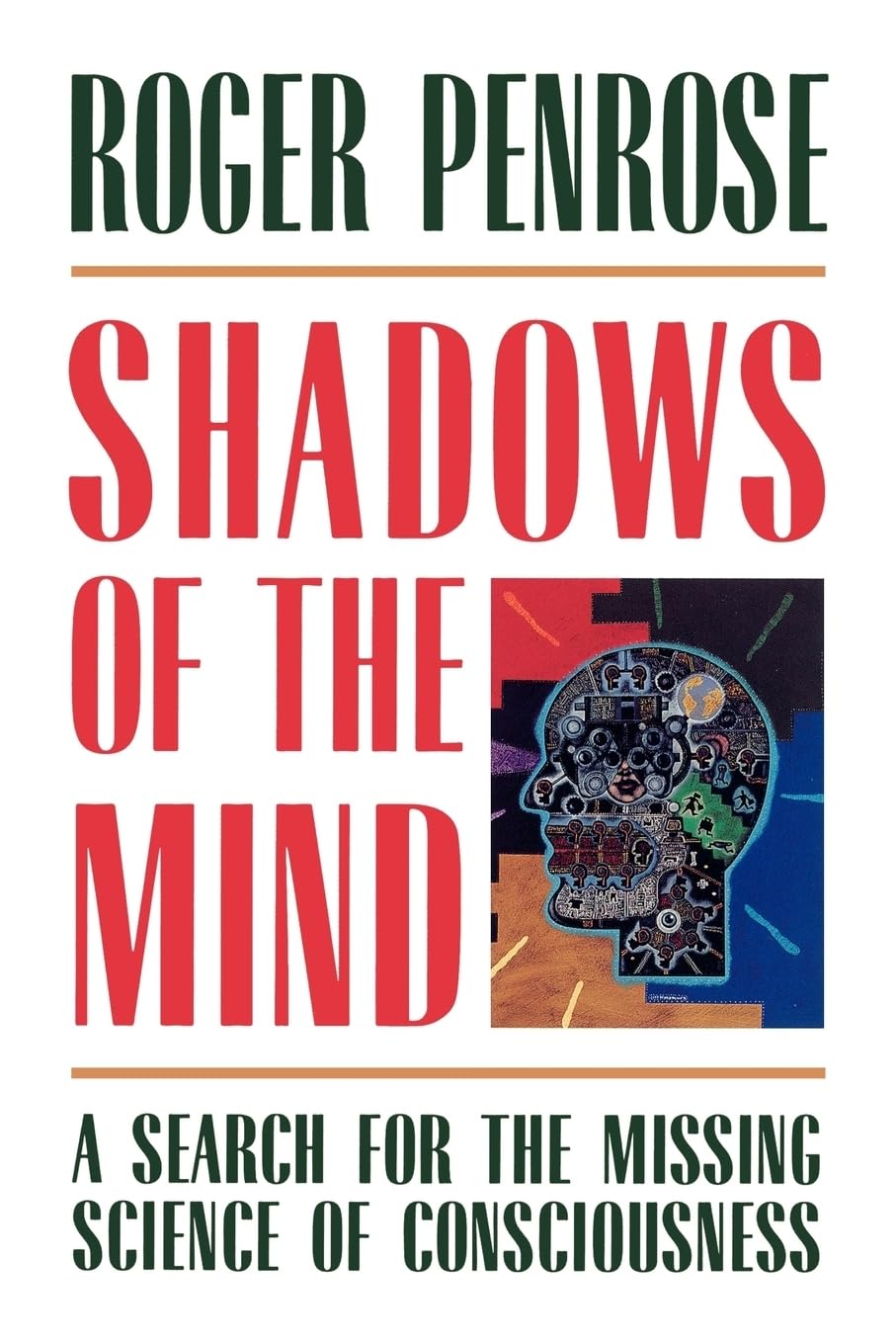
Mathematician, physicist, philosopher of mind, and Nobel laureate, Penrose has spent decades developing the argument—controversial, contested, and impossible to dismiss—that human consciousness cannot be fully accounted for by computational processes, and that Gödel's incompleteness theorems provide part of the reason why. His landmark books The Emperor's New Mind and Shadows of the Mind placed Gödel at the center of one of the deepest debates in contemporary science, and his work on the geometry of the universe, on black holes, and on the mathematical structure of physical reality has given him a perspective on Gödel's contributions that is at once technically precise and philosophically bold. In this conversation, Penrose reflects on what Gödel proved, what it means for our understanding of mind and machine, and why a set of theorems arrived at nearly a century ago in a Vienna still reeling from the collapse of one civilization and the rise of another continues to feel, for anyone thinking seriously about the nature of thought itself, less like a historical result than an open wound.
Charles Carlini: Kurt Gödel’s 1931 Incompleteness Theorem disrupted German mathematician David Hilbert’s agenda for 20th-century mathematical research and rocked the very foundations of mathematics in general. What was this pivotal insight that turned the foundations of mathematics on its head?
Roger Penrose: Hilbert was hoping to be able to formalize mathematics in a completely clear way so that the issue of whether a result was to be considered to be “proved” could be made completely unambiguous. This desire had been prompted by the appearance of “paradoxes,” such as Bertrand Russell’s "set of all sets that are not members of themselves." If some area of mathematics could be formulated in such a way that the proof procedures are completely unambiguous and clear-cut (in a sense that I shall come to below), one should be able to make sure that contradictions, such as Russell’s paradox, didn’t occur (i.e., were not part of the accepted proof procedures), then that area of mathematics would be put on a sound basis.
Gödel’s Incompleteness Theorems showed that Hilbert’s program was unachievable—at least for sufficiently broad areas of mathematics (such as the ordinary number theory of the integers). Gödel showed that for such an area of mathematics, for any proposed formal system F (a “formalization,” in the above Hilbertian sense) which intended to describe it would always fail to be able to establish some result (that could be explicitly constructed in terms of the rules of F)—let us call this result G(F)—even though G(F) could be seen to be necessarily true, by methods outside the rules of F, provided that the rules of F could themselves be trusted as yielding only true results. The form of Gödel’s result that is most commonly referred to is his “second” Incompleteness Theorem, in which G(F) effectively asserts that F is consistent, so the argument tells us that the consistency of F cannot be proved within the rules of F itself.
In my view, this has the appearance of downgrading the significance of Gödel’s theorem, perhaps giving it a circular appearance: “consistency” is a somewhat internal matter of concern.
CC: How would you explain Kurt Gödel’s Incompleteness Theorem to a layman?
RP: I prefer to state Gödel’s result in a more direct way, using Turing’s notion of computation. The point about a formal system F is that it provides a proposed method of “proof” which has the character that the correctness of any such “proof,” according to the rules of F, is computationally checkable. That is to say, there is a computer program P
To put this another way, if we accept F as giving us a sound set of procedures of mathematical proof, then we are able (via Gödel’s ingenious argument) to transcend the methods of F to see the truth of results that are beyond the scope of F. Thus, if we trust F, then we can transcend F.
CC: In your book, The Emperor’s New Mind, you made clever use of Gödel’s proof to advance the view that artificial intelligence is impossible, or that machines cannot think. Can you briefly explain the main thrust of your argument?
RP: The thrust of my argument is that the quality of “understanding” is something outside the capabilities of a computer. It is through understanding that we can use the Gödel argument to extend our belief in the trustworthiness of some F to the belief in the truth of G(F), even though G(F) is unobtainable by means of the rules of F. The generality of Gödel’s argument simply illustrates how powerful conscious reasoning (through understanding) can be. Just following rules (which is what computers do—albeit extraordinarily well) is something very different from understanding. (This is something that educationalists know very well!) I argue that understanding (whatever it is) requires “consciousness” (whatever “that” is!). To take the argument further, I take the view that the quality of consciousness is potentially out there in the physical world and is not necessarily unique to human beings. But I regard the Gödel argument as showing that conscious understanding cannot be properly imitated by a computer. So, I argue that if consciousness is part of physics—describable by the “true” laws of physics—then the true laws of physics must be non-computable. It is known (using Gödel-Turing-type arguments) that many areas of mathematics are actually non-computable, so I am claiming that the true laws of physics (not yet fully known to us) must also be non-computable. But the known laws of physics are (more-or-less) computable, so we must look outside the known laws. I argue, further, that the only plausible loophole in the laws that we know lies in the issue of quantum measurement, and that the “measurement paradox” (basically “Schrödinger’s cat”) points to where we need to make further progress in our understanding of the laws of physics in order to uncover what is actually non-computable in the true laws).
CC: It’s been 20 years since the publication of The Emperor’s New Mind. How has your viewpoint held up?
RP: In my book Shadows of the Mind, I developed these ideas quite considerably, mainly in three directions (1) strengthening the Gödelian argument (making it more rigorous) (2) improving my criterion for the onset of new physics, in relation to the “measurement paradox” (3) learning from Stuart Hameroff about microtubules, and taking the view that it must be at the level of neuronal microtubules, basically, (rather than neurons) that the required coherent quantum processes (and “non-computable beyond-quantum-mechanics” processes) must manifest themselves.
How has it held up? Of course, many people have remained skeptical. But despite the many (often aggressive) arguments from others, my arguments seem to me to have stood up well enough (and are described in the soon-to-be-published proceedings of the Vienna conference honoring Gödel’s centenary, with the approval of some of my sternest critics from the community of logicians). On the biological side, some very striking recent results concerning microtubules exist, but they are not yet published. On the quantum physics side, there are some theoretical developments, but the (extremely difficult) experiments are still being developed.
CC: Philosopher J. R. Lucas advanced a similar argument in a paper entitled “Minds, Machines and Gödel” in the journal Philosophy in 1961. Are you familiar with his paper?
RP: Yes, Lucas put forward a similar type of argument to my own before I did (and Nagel and Newman before Lucas, and Gödel before them), although I believe that my own argument has rather more mathematical rigor than Lucas’s one did. Of course, Lucas was arguing from the point of view of a philosopher, and I from the point of view of a mathematical physicist.
CC: How did Gödel’s proof influence Alan Turing’s work?
RP: Quite a lot. Turing was very impressed by Gödel’s argument, and he developed that argument further, phrasing it in terms of non-computability, more or less in the way that I have done (following Turing) above. Turing’s philosophical standpoint (at least later in his life) was different from Gödel’s, however. Gödel seemed to think that human minds must transcend physics, whereas my view is that conscious minds must transcend the presently known physics, but that physics is too limited. Turing seemed to base his later views on a computer model of minds in which the way around the Gödel theorems lies in the fact that conscious humans make mistakes. I try to argue in my books that this is an implausible let-out.
CC: Around the same time that Gödel was working on his Incompleteness Theorems, another logician by the name of Alfred Tarski was working with similar results. Why do you suppose Tarski’s work hasn’t garnered as much attention as Gödel’s?
RP: I don’t know the history well enough. Several other logicians were onto the same sorts of issues as Gödel. My guess is that Tarski’s results weren’t as developed as Gödel’s at the time, but I don’t really know the details. I had the impression that Gödel’s results were a bit of a bombshell, though they took a while to be fully appreciated.
CC: Another fundamental result that Gödel worked on was his proof of the consistency of two problematic hypotheses with the axioms of set theory in 1939. Can you briefly explain this?
RP: I think this must refer to the Gödel work that was carried on by Paul Cohen. They showed that Cantor’s continuum hypothesis and the axiom of choice (two famous assertions in mathematics) cannot be proved or disproved within one of the standard formal systems for mathematics (known as the Zermelo-Frankel system). This is very interesting, of course, but as we already know from the Gödel Incompleteness Theorems, proof within a specific formal system is not the same as being able to see that something in mathematics is true or false by general mathematical argument.
CC: Gödel also dabbled outside of his field of expertise by proving that time travel to the past was possible under Einstein’s equations. Should we give any credence to his proof?
RP: He only showed that such time travel was possible within his specific cosmology. This, of course, is fascinating, but we don’t know that this particular cosmological model actually holds for our own universe. Yet Gödel’s arguments were ahead of their time and certainly influential in the development of relativity theory.
CC: Like Gödel, you are a Platonist who views mathematical truth as "absolute, external, and eternal, and not based on man-made criteria." Is there any proof one can evince to support such a standpoint? Or is it just a belief?
RP: I think there are many possible different understandings of what "Platonism" means. Some "Platonists" like Gödel were very "strong Platonists" in the sense that they would believe that all mathematical statements must have an absolute truth value—so the truth is, in a sense, "out there," and not the product of our minds, having some subjective aspect to them. In my own case, I do not feel so strongly as Gödel seemed to that all mathematical truth is objective, but I would probably go much of the way with him. There is a separate issue regarding the basis of physical reality. Is physical reality based on a deeper mathematical reality? I think that my own picture is best expressed in my "Three-worlds" picture (in "Shadows of the Mind" and "The Road to Reality"), in which I indicate how the physical world, the mental world of conscious experience, and the Platonic world of mathematical forms inter-relate to one another via three "mysteries". This is not really a belief system, however, but rather a clarifying picture.
Recommended Reading


0 comments