

He wrote as if the highway itself were a form of thought—lanes unspooling across the continent while America searched, nervously and noisily, for its own soul.
Few writers captured the restless energy of postwar America as vividly as Jack Kerouac. If the 1930s had belonged to socially minded novelists like John Steinbeck, and the war years to sober chroniclers of global upheaval, the late 1940s and 1950s produced something looser, more improvisational. Kerouac became the unofficial bard of that shift. His work, especially the novel On the Road, gave voice to a generation that felt hemmed in by conformity and eager to test the open spaces of American possibility.
Yet Kerouac’s reputation has long oscillated between romantic myth and sober reassessment. To admirers, he was a visionary of freedom; to critics, an undisciplined mystic who mistook rambling for revelation. The truth lies somewhere between. Kerouac was a writer of genuine originality whose spontaneous style masked careful craft and whose romantic longing concealed a deep, often painful sense of displacement.
A French-Canadian Childhood
Jean-Louis Lebris de Kerouac was born in 1922 in Lowell, Massachusetts, a mill town thick with immigrant life. His parents were French Canadians, and the household language was Joual, a Quebecois dialect of French. English came later, and the experience of linguistic transition shaped Kerouac’s ear. Even in adulthood his sentences carried echoes of bilingual rhythm.
Lowell itself left a lasting imprint. The mills, the river, the dense working-class neighborhoods—these environments fed his early sense that American identity was not monolithic but layered. Kerouac later wrote nostalgically of this upbringing, especially in novels such as Doctor Sax and Visions of Gerard. Beneath the Beat generation mythology lay a writer haunted by childhood memory and Catholic imagery.
Athletic talent first seemed to offer him a route out of Lowell. Kerouac earned a football scholarship to Columbia University in New York. A leg injury and clashes with coaches derailed that path, but the move to New York proved decisive. There he encountered figures who would form the nucleus of what later came to be called the Beat Generation.
The Birth of a Circle
In the mid-1940s Kerouac met Allen Ginsberg, William S. Burroughs, and the charismatic drifter Neal Cassady. The group’s conversations ranged across literature, jazz, philosophy, and crime. They were drawn to experience as much as to art. Drugs, sexuality, and cross-country wandering became part of a loose experiment in living.
Kerouac, however, was the one who transformed this bohemian milieu into narrative. He kept notebooks obsessively. Road trips across the United States, often with Cassady, became the raw material for his most famous work.
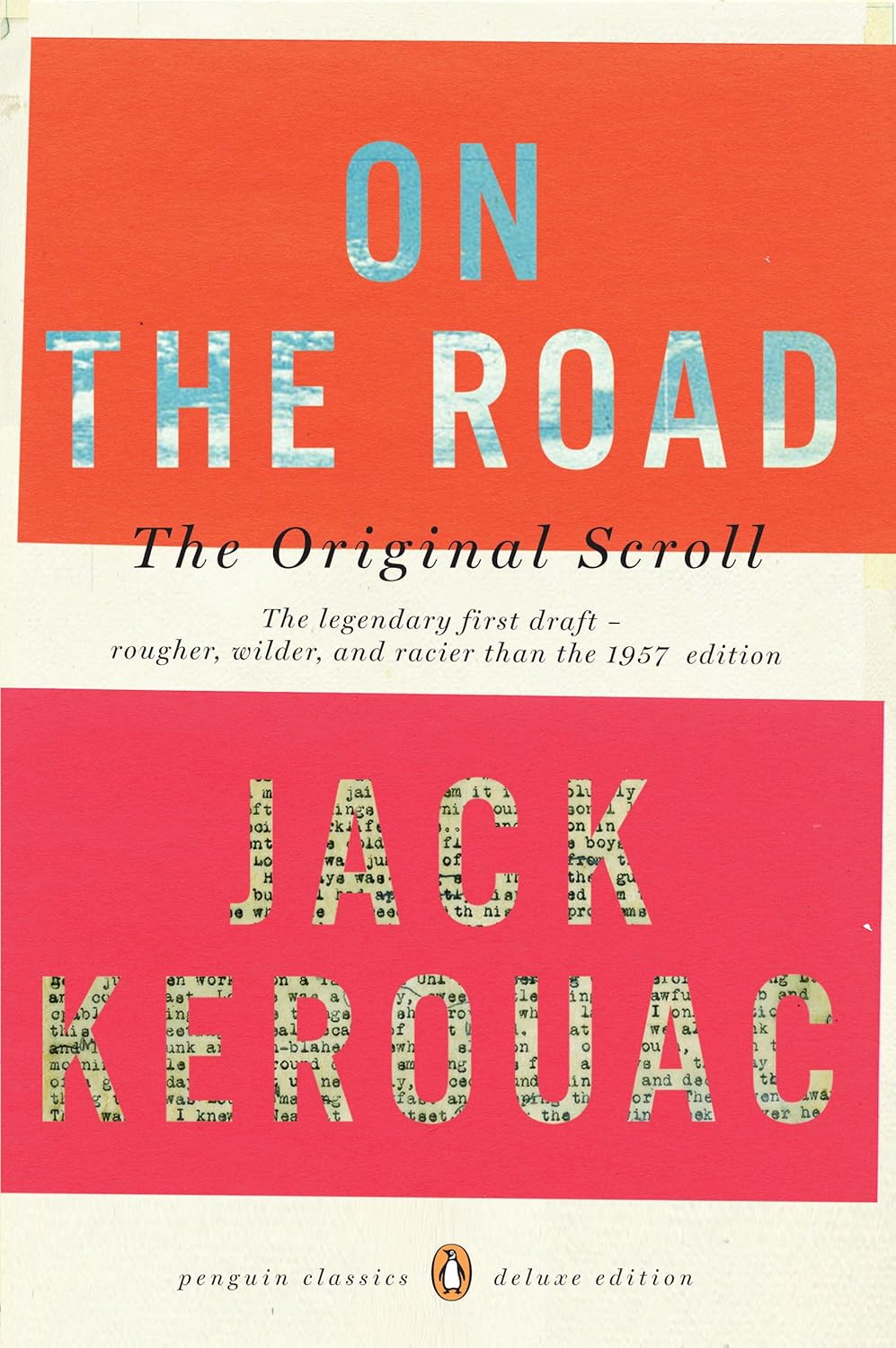
The result was On the Road (1957), a novel that reads like a continuous burst of motion. Kerouac reportedly drafted the original manuscript in a three-week burst on a long roll of paper, attempting to capture thought at the speed of travel. The book follows Sal Paradise (Kerouac’s alter ego) and Dean Moriarty (a thinly veiled Cassady) as they crisscross America in search of intensity—jazz clubs in Denver, night drives through the Midwest, ecstatic conversations that blur into dawn.
One passage captures the book’s breathless enthusiasm
“The only people for me are the mad ones, the ones who are mad to live, mad to talk, mad to be saved.”
The line has been quoted so often that it risks cliché, yet it still conveys the emotional voltage that electrified readers in the late 1950s.

The Sound of Spontaneous Prose
Kerouac described his method as “spontaneous prose.” The phrase suggests improvisation, and indeed he admired the structure of jazz solos. Musicians like Charlie Parker and Dizzy Gillespie inspired him to write in cascading rhythms, allowing sentences to stretch and tumble.
Yet spontaneity was partly a myth of presentation. Kerouac revised extensively in other works, and even the famous scroll draft of On the Road underwent editing before publication. What he sought was not chaos but velocity, a prose style capable of matching the pace of thought and the unpredictability of travel.
His sentences often surge forward in long, breathless arcs. Punctuation loosens. The narrative eye darts from landscape to conversation to introspection. In the best passages, the effect resembles a camera mounted on a moving train.
Fame and the Beat Explosion
When On the Road finally appeared, after years of rejection, it struck a cultural nerve. America in the 1950s was outwardly prosperous yet inwardly restless. Suburban expansion, corporate employment, and Cold War anxiety produced a sense of conformity that younger readers found suffocating.
Kerouac’s novel offered an alternative vision. Here was a country not of tidy lawns but of highways, diners, deserts, and midnight conversations. Movement itself became a philosophy.
The media quickly seized on the idea of the “Beat Generation,” a label that Kerouac himself had used but which journalists transformed into a caricature. Coffeehouses filled with black turtlenecks and bongo drums. Kerouac, shy and deeply ambivalent about celebrity, found himself cast as spokesman for a movement he never fully controlled.
His relationship with the Beats was complicated. While Ginsberg embraced public activism and Burroughs pursued experimental fiction, Kerouac remained oddly traditional at heart. He admired Thomas Wolfe and Walt Whitman. He believed in the romantic sweep of American literature even as he rebelled against its conventions.
The Shadow Behind the Myth
Kerouac’s fame brought not liberation but pressure. He struggled with alcoholism and increasing isolation. Critics sometimes dismissed his work as self-indulgent. Later novels, including The Dharma Bums and Big Sur, revealed a writer grappling with exhaustion and spiritual confusion.
In Big Sur (1962), the carefree wanderer of On the Road appears older, frayed, and anxious. The Pacific coastline becomes a landscape of psychological collapse rather than liberation. Kerouac’s search for transcendence, whether through Buddhism, travel, or intoxication, seems suddenly precarious.
This darker dimension complicates the Beat myth. Kerouac’s celebration of freedom was inseparable from a deep vulnerability. His writing records both exhilaration and burnout.
The Catholic Mystic of the Highway
Despite his association with counterculture rebellion, Kerouac never abandoned his Catholic upbringing. Religious imagery surfaces repeatedly in his writing. His road journeys sometimes read less like tourism than pilgrimage.
He also explored Buddhist ideas, fascinated by notions of impermanence and detachment. Yet his spirituality remained eclectic and unsettled. Kerouac sought transcendence in motion itself, in the possibility that travel might dissolve the boundaries of self.
The American landscape became a metaphysical stage. Deserts, plains, and mountain passes were not merely scenery. They represented freedom, loneliness, and the promise of reinvention.
An Enduring Restlessness
Kerouac died in 1969 at the age of 47, his health wrecked by years of heavy drinking. By then the cultural moment he helped ignite had evolved into the broader upheavals of the 1960s. Yet his influence persisted. Writers, musicians, and filmmakers continued to draw inspiration from the idea that art might capture the immediacy of lived experience.
Today On the Road remains a rite of passage for many readers, though its meaning has shifted. Some now see it less as a manifesto of freedom than as a document of youthful yearning. Others admire its energy while questioning its blind spots, particularly its treatment of women and its romanticization of marginal communities.
What remains undeniable is Kerouac’s contribution to literary rhythm. He expanded the possibilities of narrative voice, proving that prose could move with the improvisational momentum of jazz.
He wrote as if the road were endless and the night full of revelation. America, in his pages, becomes a landscape of possibility and melancholy—vast, improvised, and forever unfinished.
Recommended Reading


0 comments