

How does a writer from Elizabethan England still manage to capture the human heart with such uncanny precision? Four centuries after his death, William Shakespeare remains the most performed, most quoted, and most studied playwright in the world. His words have shaped the English language itself, and his plays, whether the dark tragedy of Macbeth, the existential depths of Hamlet, the doomed passion of Romeo and Juliet, or the wild enchantment of A Midsummer Night’s Dream, continue to ignite stages and imaginations across every culture and continent.
Born in Stratford-upon-Avon in 1564, Shakespeare rose from provincial obscurity to become the defining voice of the English stage. His body of work spans comedies, histories, tragedies, and poems, probing themes of love, ambition, betrayal, power, and the mysteries of human identity. While scholars and audiences may debate the particulars of his life, the universality and vitality of his writing remain undeniable. He is less a figure of the past than a companion to the present, whose lines feel as alive now as when they first echoed through the Globe Theatre.
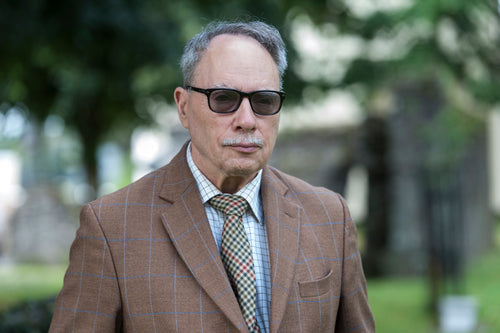
Few scholars have done more to illuminate Shakespeare’s legacy than Peter Holland, McMeel Family Professor in Shakespeare Studies at the University of Notre Dame. A prolific author and editor, Holland has shaped the field through his books, including English Shakespeares: Shakespeare on the English Stage in the 1990s and The Ornament of Action: Text and Performance in Restoration Drama, as well as his stewardship of Shakespeare Survey. His editions of plays such as A Midsummer Night’s Dream for the Oxford Shakespeare series have become touchstones for readers and performers alike.
In this interview, Holland reflects on Shakespeare’s enduring power and relevance, drawing on a lifetime of scholarship and leadership, including his term as president of the Shakespeare Association of America. With insight and clarity, he explores what makes the Bard’s works so endlessly adaptable, how they continue to resonate with audiences today, and why Shakespeare’s voice still speaks to the deepest truths of the human condition.
Charles Carlini: To this day, William Shakespeare is widely regarded as the greatest writer in the English language. What, in your view, makes him the "greatest?"
Peter Holland: The brilliance of turning narrative into drama, the astonishing nature of his ability to create characters on stage, the depth of possibility in his language, and how his plays mean so many things in such different cultures across the world and across time.
CC: What is your view of the “authorship debate,” which brings forth the idea that someone else actually wrote maybe some (or perhaps even all) of the plays that have been attributed to the Bard?
PH: There is no convincing evidence whatsoever that anyone other than William Shakespeare wrote the plays.
CC: In the context of the Elizabethan era and the prevailing mores of that period, were his plays considered mainstream or avant-garde?
PH: The words “mainstream” and “avant-garde” don’t mean anything for the early modern period. But Shakespeare was a great innovator and changed the way plays could be written.
CC: Did Shakespeare act in any of his own plays?
PH: So early gossip said, and there is some evidence, for example, his being listed as an actor in plays by his contemporary Ben Jonson, that he did act. But, given that the traditional high point of his acting career was said to have been the small role of Adam in As You Like It, it doesn’t suggest that he was very good!
CC: Was he influenced by any other authors?
PH: Of course. He was profoundly influenced by, for instance, Marlowe as a playwright and by his favorite classical writers like Ovid, Plutarch, and Apuleius.
CC: The majority of Shakespeare’s plays were published after his death. Why did he not publish them in his lifetime?
PH: Half of his plays were published in his lifetime, some in many editions; the other half were included, after his death, in the collection of his work that his colleagues, Heminges and Condell, put together. Plays did not belong to the playwrights but to the companies that bought them. So he didn’t ever publish any of his plays; the King’s Men did. Remember that most plays written in the period were never published; publication was less important than performance.
CC: What is the importance of the First Folio, containing 36 of Shakespeare’s plays?
PH: Obviously, without the First Folio, we may never have been able to read half of his work, plays like Macbeth and Antony and Cleopatra, The Tempest, and Coriolanus. I see it, along with the King James Bible, as the most important book of the English Renaissance.
CC: His play, Cardenio, was performed during his lifetime but has since been lost. What do we know about it, and is there any way of recreating it?
PH: No, there is no way to “recreate” it. We know it was based on some material in Cervantes, but not any details of its turn from narrative to drama. Lewis Theobald, in the early 18th century, published a play, The Double Falsehood, which may have been based on the play Shakespeare co-wrote with his younger contemporary John Fletcher. Of course, as with the new production of a play by Charles Mee and Stephen Greenblatt, one can always write a play using some of the same materials Shakespeare used.
CC: In the last few years, many critics have begun to reassess a play called Edward III, currently grouped with a collection of 11 other plays known as the Shakespeare Apocrypha. Another play, Sir Thomas More, has also been examined. Handwriting analysis has led scholars to believe that Shakespeare revised parts of Sir Thomas More, but, like Edward III, it is not part of the standard collection of Shakespeare’s plays. What is your view?
PH: I do not doubt that Shakespeare was Hand D, as the handwriting is called, one of the authors of Sir Thomas More, contributing the wonderful scene of the May Day riot, and equally no doubt that he wrote the Countess of Shrewsbury scenes in Edward III. There are other scenes, like a scene in the anonymous play Arden of Faversham, which may well be by Shakespeare. And of course, there are plenty of plays in the First Folio that are collaborations: Macbeth, Timon of Athens, Henry VI Part 1, Henry VIII, Titus Andronicus.
CC: Was the language he used in his works actually the spoken language of his time, or was it only the literary/theatrical language?
PH: It’s both. This was a time when English was coining words at an astonishing rate; some may be Shakespeare’s coinages, others not. Lacking direct evidence, we can only guess what the spoken language of the time was like, but when Cordelia says to King Lear ‘No cause, no cause’ or Hamlet says ‘To be or not to be; that is the question’, they sound as if they are speaking a very ordinary language in very remarkable ways.
CC: How does a teacher/professor motivate today’s students to read Shakespeare?
PH: By showing them that the plays are fun, engaging, exciting, powerful, thoughtful, and exhilarating works. Without engaging students in performance, there is no point in trying to encourage them to read.

0 comments