

In the winter of 1884, Georg Cantor suffered his first complete mental breakdown. He was thirty-nine years old and had spent the previous decade constructing one of the most radical intellectual edifices in the history of mathematics: a rigorous theory of the infinite, complete with a hierarchy of infinities, each one provably larger than the last. The mathematical establishment, led by his former mentor Leopold Kronecker, had responded with contempt. Kronecker called him a corrupter of youth and worked behind the scenes to block his publications and prevent him from obtaining a position in Berlin. The rejection was not merely professional. For a man who believed, with genuine religious conviction, that his ideas about infinity had been revealed to him by God, to have them dismissed as nonsense was something close to unbearable.
Cantor recovered, returned to his work, and broke down again. And again. The pattern repeated itself across three decades, with periods of extraordinary productivity alternating with prolonged stays in sanatoriums. He died in one in 1918, still defending a vision that the mathematical world had by then begun, quietly and belatedly, to accept. Within a generation, the set theory his contemporaries had mocked would become the foundation on which all of modern mathematics was built.
It was an act of intellectual daring shadowed at every step by personal cost, and it is precisely this combination that captures the imagination of mathematician and historian Amir D. Aczel. Cantor's great provocation had been to introduce set theory and the concept of transfinite numbers, an audacious attempt not merely to gesture at the infinite but to understand, classify, and order it with mathematical precision. His ideas are now foundational to modern mathematics, yet in his own time they were met with resistance that went beyond academic disagreement, touching something deeper in the way his contemporaries understood the boundaries of human knowledge and the proper limits of mathematical inquiry.
A lecturer at Harvard and other leading institutions, Aczel was known for bestselling books that bring abstract theories to life through vivid human storytelling. In works like Fermat's Last Theorem, he explored the passions, obsessions, and setbacks that shape great ideas as much as the ideas themselves. In Cantor's story, he found not just a mathematical pioneer but a portrait of genius at odds with its time, and a reminder that the history of mathematics is also, inescapably, a history of human struggle. In the conversation that follows, Aczel guides us into that story and into the strange, vertiginous world Cantor built at the edge of the thinkable.
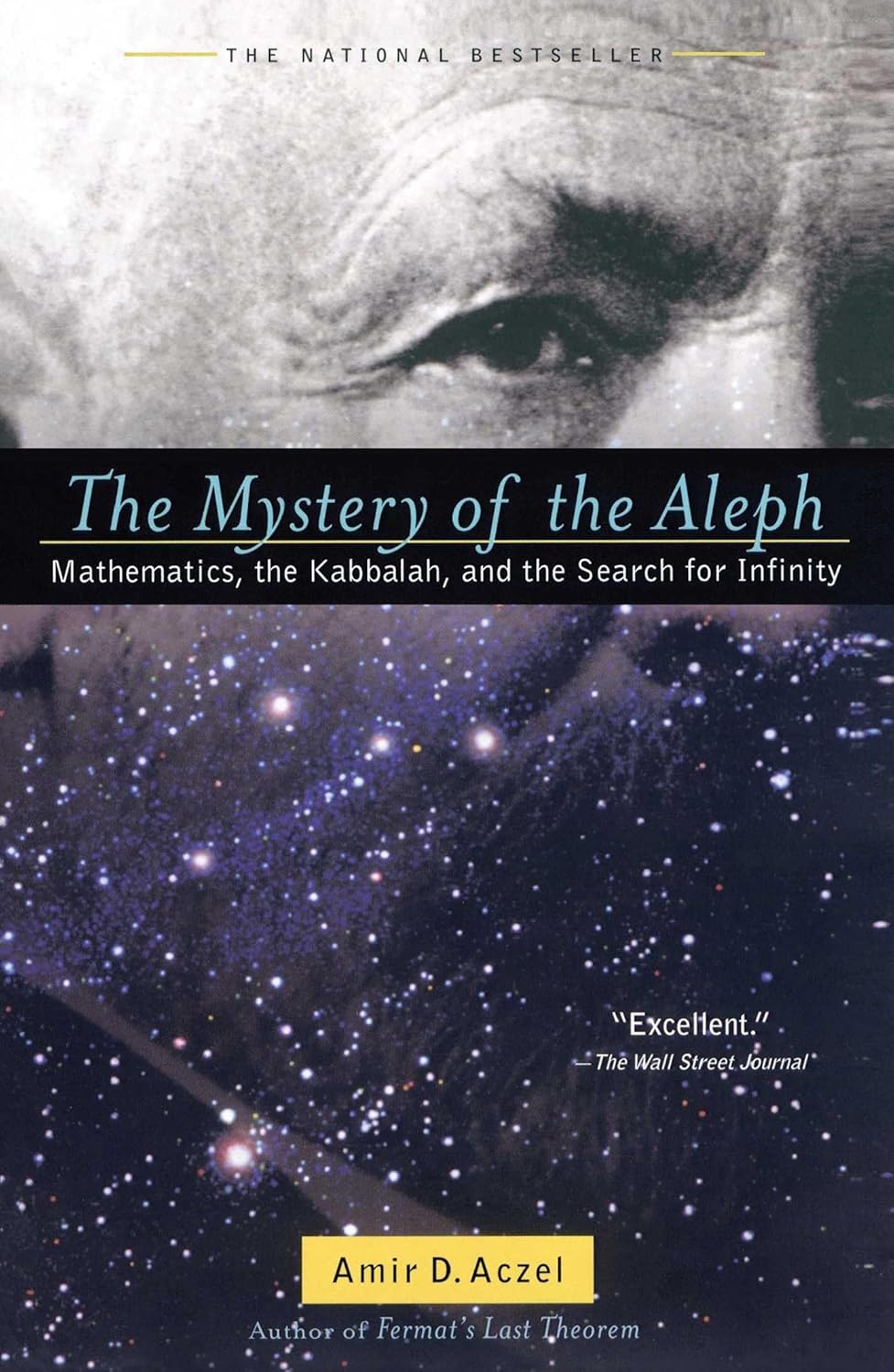
Charles Carlini: You are a highly prolific scientific author, having written about everything from Descartes to quantum entanglement to European cave art. In your book A Strange Wilderness, you bring that experience to write about the lives of great mathematicians, including Cantor. What prompted you to include Cantor among the ranks of Archimedes and Newton? How did you research Cantor’s life, both for Wilderness and for Mystery of the Aleph?
Amir Aczel: Cantor was the first person in history to truly understand infinity. He knew—when no one else did—that there are many kinds of infinity, not just one. And his methods of proof were novel and powerful. He was able to show that the integers were of a lower order of infinity than the “real numbers.” This was because the irrational numbers—in particular, the transcendental numbers such as pi and e—were far more numerous, comprising a larger form of infinity than that of the integers. He was able to show, using an ingenious "diagonal proof" that, in fact, the rational numbers, that is, fractions made of numerator and denominator, both integers, are of the same order of infinity as the integers. Equally, using another ingenious proof, he was able to show that there are as many numbers in a square as there are in a line segment! He described that stunning finding to a friend as: "I see it, but I can't believe it!"
CC: The concept of infinity was crucial to Cantor’s research and had considerable philosophical implications that caused an uproar among his colleagues. How did Cantor define the term “infinite?” Why was it that before Cantor, mathematicians, philosophers, and theologians alike all rejected the concept of infinity?
AA: Because it was—and still is—just too hard for humans to understand.
CC: Your book, Mystery of the Alep,h takes its title from aleph numbers, which Cantor invented to represent the cardinality of infinite sets. Why did he choose the Hebrew letter “aleph” as a name? How did the creation of aleph numbers contribute to Cantor’s theory of infinity?
AA: We don't really know. I guess that this was because of his Jewish roots and some familiarity with Hebrew, in which Aleph is the first letter. Cantor used the Alephs to denote his levels of infinity. In his most important—never completed—piece of work called the "Continuum hypothesis," he tried to show that aleph-1 is equal to 2 raised to the power aleph-zero, meaning that the continuum of the real numbers is the next-higher level of infinity after that of the integers and rational numbers. He failed in proving it, and we still don't know whether this is true. It has been shown by Kurt Gödel and Paul Cohen that such a proof is beyond our mathematics.
CC: Could you briefly summarize the major points of Cantor’s research? What were his most important contributions to the field of mathematics?
AA: Everything having to do with the modern understanding of infinity, really. The continuum hypothesis is the most important. Also, Cantor was able to show that the "algebraic numbers"—those that may be irrational but are roots of polynomial equations with rational coefficients—are also countable, meaning they are of the same lower level of infinity as are the integers and rational numbers. The entire understanding of infinity is due to Georg Cantor.
CC: Throughout his life, Cantor struggled with fierce opposition to his theories, both on religious and scientific grounds. Intuitionists such as Henri Poincaré referred to Cantor’s theories as the “disease infecting mathematics.” On what was the opposition to infinity based? Was and/or is there any merit to the criticisms of Cantor’s theories?
AA: Kronecker said, "God made the integers, and all the rest is the work of man." Leopold Kronecker based his decades-long opposition to Cantor on that assumption. There was a belief at the time that irrational numbers did not really exist. These numbers had bothered the ancient Greeks, and they avoided them. Kronecker and his allies were of that belief, but Cantor could see far beyond this limiting view and understand infinity.
CC: By all accounts, Cantor was deeply unsettled by the criticism he received—even when it came from friends, like Magnus Gustaf Mittag-Leffler, asking him to withdraw a paper because it was “a hundred years too soon.” Is there any record of what Cantor was like in his personal life?
AA: He was a devoted husband and father. He was plagued with mental problems and attacks on his work by Kronecker and his allies in Berlin.
CC: Kronecker, under whom Cantor studied, was one of the most significant figures in Cantor’s life, but later became one of the fiercest opponents of his theories. How did their conflicting views on number theory impact their relationship?
AA: It was a philosophical disagreement on infinity and what it means. Cantor understood actual infinity while most of his contemporaries did not. It required a sea change in their thinking to understand Cantor's great work. Today, every graduate student in mathematics knows Cantor was right in his understanding that infinity has different levels, and this field has grown. But we still don't know anything about the continuum hypothesis.
CC: Cantor suffered from terrible depression throughout his life, commonly attributed to the overwhelming criticism he received from his colleagues. Recently, however, some have suggested that mental illness may have played a role in Cantor’s depression. Do you believe this to be the case?
AA: That is true. He had bipolar disorder, and Kronecker's attacks didn't help. It is hard to assign causes to his illness, but both the criticisms of his work and his inability to solve the continuum hypothesis made his mental illness flare up, requiring frequent hospitalizations.
CC: Cantor was 68 when World War I broke out, and he died the year it ended. What was the impact of the war on Cantor, who was already suffering from depression and several hospitalizations? Was this representative of the war’s impact on the mathematics community at large?
AA: He died of starvation at the Halle Nervenklinik. This was all the war's effect.
CC: As a figure of considerable mathematical controversy and interest, it only follows that historians have misinterpreted details of Cantor’s life. As one of his biographers, what are some common misconceptions about Cantor that you’ve encountered?
AA: That's a tough one. People have written about Cantor without understanding his math (I won't mention names, but one of them is very well-known). Cantor's life was his math. And that math was, for the most part, the very difficult idea of infinity.
Recommended Reading


0 comments