

In 1936, a 68-year-old architect who had not received a significant commission in nearly a decade was handed a modest budget and asked to design a weekend retreat for a Pittsburgh department store owner on a wooded site in rural Pennsylvania. What Frank Lloyd Wright produced, in a white heat of creativity that astonished even his closest associates, was Fallingwater: a house cantilevered directly over a waterfall, its horizontal planes of reinforced concrete hovering above the rushing water as if defying not just convention but gravity itself. When it was unveiled, the architectural establishment, which had largely written Wright off as a relic of a previous era, fell silent. Time magazine put him on its cover. Fallingwater was not the work of a man in decline; it was the work of a man who had been waiting, with terrifying patience, for the world to catch up. He was just getting started. He would live and build for another 23 years, designing the Guggenheim Museum, among hundreds of other structures, before dying at 91 with a drafting pencil still within reach.
Frank Lloyd Wright (1867–1959) was not merely the greatest American architect of his time. He was, by most measures, the most original architectural mind the country has ever produced, a figure whose influence on the built environment extended so far beyond his own buildings that it reshaped how an entire civilization thought about the relationship between structure, nature, and human life. Over a career spanning seven decades, he produced more than a thousand designs ranging from prairie houses to churches to museums, each one an argument against imitation and received wisdom, each one insisting that America had no business building as if it were still Europe. His concept of organic architecture, in which buildings grew from their sites and their purposes rather than being imposed upon them, was less a stylistic preference than a philosophical conviction, and he pursued it with the zeal of a man who believed architecture was a moral act.
Wright was also, by any honest account, one of the most combustible and contradictory figures in American cultural history. He was serially unfaithful, financially reckless, monumentally self-aggrandizing, and capable of cruelty toward the people who loved him most. His personal life generated scandals of operatic intensity, including a 1914 tragedy at his Wisconsin home, Taliesin, in which a deranged employee murdered seven people and burned the buildings to the ground, which would have destroyed most men entirely. Wright rebuilt Taliesin, rebuilt his practice, and rebuilt his legend with the same restless energy he brought to everything, as if catastrophe were simply another design problem requiring a sufficiently bold solution. Understanding Wright fully means holding the genius and the wreckage together, because in his case, as perhaps in no other, they were genuinely inseparable.
To navigate that difficult terrain, we turn to Robert Twombly, who teaches architectural history at the City University of New York and has devoted much of his scholarly career to the titans of American architecture. The author of biographies of both Frank Lloyd Wright and Louis Sullivan, the visionary Chicago architect whom Wright revered as his greatest teacher, Twombly brings to his subject both the historical sweep to place Wright within the full arc of American architectural development and the biographical precision to recover the complicated human being behind the monuments. He has also edited Sullivan's public papers, giving him an unusually intimate understanding of the intellectual world from which Wright emerged. In this interview, he reflects on Wright's revolutionary vision, his spectacular personal failures, and why a man who spent his entire career insisting that America needed to find its own architectural voice remains, more than six decades after his death, the most American of architects.
Charles Carlini: Can you begin by giving us a brief sketch of Frank Lloyd Wright’s background—where he was born, his childhood, and his family?
Robert Twombly: Wright was born in Richmond Centre, Wisconsin in 1867. His father, William, was a minister/preacher—sometimes Baptist and at other times Unitarian. His mother, Ada, came from a very prosperous Jones family—Welsh immigrants to the United States, who lived in the Spring Green area of Wisconsin. After Ada and William had been married, they lived briefly in Iowa and Massachusetts and then returned to Madison, Wisconsin. As a young boy, Wright spent a great deal of time on the Lloyd Jones Farms, so he became familiar with the countryside around Spring Green and developed a lifelong love of the land. At 17, Wright’s mother filed for divorce, claiming what we would call today “sexual incompatibility.” We can assume that there was a lot of tension in the family while Frank was growing up.
CC: And what about his education?
RT: Wright went to the University of Wisconsin for one year. Although he wrote in his autobiography that he quit in his senior year just short of graduation to prove he didn’t need formal education, in fact, he only stayed one year. He then moved to Chicago, where he got a job with a prominent architect named Joseph Lyman Silsbee, who had designed the Lloyd Jones Family Chapel in Spring Green. Wright, although a teenager at that time, had more or less supervised the construction, so when he dropped out of college and went to Chicago in 1887, he asked Silsbee for a job. But then, in 1888, architect Louis Sullivan was designing the Chicago Auditorium Building—the largest building in North America at that time—and he needed draftsmen. Wright came in with a portfolio of drawings and was immediately hired.
CC: What would you say are some of Wright’s earliest influences, which he carried throughout his life and which inspired his work?
RT: One of his earliest influences was Louis Sullivan, who was probably the foremost, most creative American architect at the time. He is known for his ornaments, which are based on vegetal and organic forms. Wright took the idea of organic vegetal forms and applied it to buildings; that’s how the term “Organic Architecture” originated. Another influence was Silsbee, of course, and the land itself. If you walk around Spring Green, as I have, there is a sandstone land formation there. The stratum of the rock foundation is laid up in a way that Wright almost literally copied for the rear of a house that he designed later. He was very much attuned to site specificity, as well as environmental factors.
CC: During the early 1900s, Wright completed a series of residential commissions, which became known as Prairie Houses. What were they, and why were they known as such?
RT: After Wright left Sullivan in 1893 and went into independent practice, he did a series of buildings, mostly houses, which was the way his whole career unfolded. About two-thirds of all his commissions came from a single family home, which is very unusual for a world-class architect. In retrospect, the years from 1893 to 1901 were a period of experimentation with materials, roof configurations, and floor plans. In 1901, he published a series of articles on new ideas for houses, and he called it “A home in a Prairie Town;” that’s how Prairie Architecture or Prairie School of Architecture originated. That name was inspired by the gently rolling land and great views of the Wisconsin prairie where Wright grew up. Accordingly, he designed houses that were low and long, ground-hugging, and intended to reflect the general length of the land in the prairie. Inside those houses, Wright designed the floor plan: he integrated the living room and the dining room closer together, with half walls or very wide openings between the two rooms. He also increased the number of windows for a better view. In other words, Prairie Houses had a more open floor – not as open as we are used to having today, but certainly more open than what people were used to having in a standard Victorian home of the era. The idea, I think, was to bring the family together.
CC: As Wright began gaining recognition for his work during his Oak Park years, his world began to unravel through a series of scandals, which also caused money problems. Can you describe this tumultuous event?
RT: Wright married a woman named Katherine Tobin in 1889; they were both very young. He was in his 20s, and she was younger. By 1901, they had six kids. So, one can only suppose that his wife stayed at home while he worked in his Chicago office. He was involved in all kinds of artistic and architectural activities; intellectually, he was growing by leaps and bounds. In 1904, he met the Chaney family, who hired him to design a house for them at Oak Park. He and Mamah Borthwick Chaney had an affair, and all the while the two couples—the Wrights and Chaneys—spent a lot of time together socially. But eventually, in 1909, the affair became very public when Wright and Mamah sailed to Berlin together, where Wright had two major books published.
Upon their return to the United States a year later, Mamah divorced her husband; Wright could not get a divorce, so he and Mamah moved together to Spring Green, Wisconsin, where he was building a home and studio for himself called Taliesin (the Welch word for “shining brow” because the house was built on the brow of a hill rather than on top of it). The two lived in the house together, creating a considerable scandal; even architectural magazines condemned Wright for immoral behavior. In 1914, a servant named Carlton set fire to the house while Mamah was there with her two children. She and the servants couldn’t get out of the windows, so they tried to break through the door, and when they did, Carlton murdered them with an ax. So, seven people were killed, one person survived, and many people saw this as God’s just and righteous punishment for living in sin.
Shortly after that, on the basis of a letter that Wright received from a woman named Miriam Noel, he invited her to Taliesin, and they began to have an affair, which also sparked a lot of criticism. That relationship lasted for six to seven years; they got married but separated shortly after, when Wright met yet another woman and had a child with her. Finally, when Wright was able to get a divorce from his second wife, he married his third wife, and they lived happily ever after. But from 1909 to the late 1920s, at a time of tremendous prosperity for architects, Wright was getting very little work, mostly because he was seen as a sinner.
CC: One of the few jobs Wright had during this terrible period was a major commission from Tokyo to rebuild the Imperial Hotel, which was a model of engineering savviness. Can you tell us a little about this commission?
RT: That was in 1913. Wright did most of the preliminary work on this hotel in the United States, but then traveled to Berlin several times over the next few years. The building opened in 1922 or 1923. The process of designer construction was a long one because the building was enormous and built by hand from local stone. This was one of the few commissions that Wright had during his “scandalous” period, and he made a lot of money from that particular assignment, but he wasn’t getting much else until 1928. The real amazing story about this is that Wright had designed a foundation system for the Imperial Hotel consisting, if you can imagine, of lily pad—concrete discs of a certain diameter that sat at the top of what was essentially mud; it was very resistant because when a tremendous earthquake came in 1922, the hotel, which sat on the edge of the quake area, had very little damage. The damage was much more extensive, however, in 1946, as a result of US bombing.
CC: You mentioned earlier the home Wright built, known as Taliesin, which had become the center of his universe. Can you tell us a bit more about it and the Taliesin fellowship?
RT: Taliesin has a long and very unusual history—it was built for Mamah Borthwick in 1911 and then burned down in 1914. It was repaired, and Wright made improvements to it. But in 1925, in the middle of his difficulties with his second wife Miriam Noel, it burned again because of an electrical fire and had to be rebuilt for the second time. In 1929, the stock market crashed, sparking the Great Depression, and Wright was not getting any work; he had less than half the commissions he received before 1909. In 1932, he started a school called the Taliesin Fellowship where students paid him tuition to rebuild and maintain Taliesin, grow its food, and do all the physical labor as a kind of apprenticeship. Wright put many of his ideas on paper and, the students did the final rendering, learned how to draw and do all the other tasks an architect would do.
By the time World War II was over, architecture had come back, and Wright had a staff of apprentices who were willing and able to work for him. In most cases, the architect pays assistants, but in this case, they paid him for the privilege of working for him. It was a good idea, and many people who started out this way found it useful. This was the nucleus of the Frank Lloyd Wright School of Architecture. In the end, there were very few architects who made an impact on the profession or who mattered on their own once they left Wright. It was hard to imitate the master.
CC: One of Wright’s most famous commissions was Falling Water, considered by many to be America’s most extraordinary home. Can you tell us about this structure and the half-told story behind its making?
RT: There are a couple of nifty stories about Falling Water; it was commissioned by Edgar Kaufmann, who was a department store magnate in Pittsburgh, as a weekend home. Wright was selected because Kaufmann’s son, Edgar Kaufmann Jr., was Wright’s apprentice for a brief period and recommended Wright as an architect. After Wright got the commission, Kaufmann didn’t hear anything for months. Finally, he sent a telegram telling Wright that he’d be coming to Taliesin to see the drawings for Falling Water. His apprentices reminded him that he hadn’t done any drawings, but he said, “it’s all in my head.” So, just before Kaufmann came, Wright drew the plans for Falling Water.
There is also another interesting story about Falling Water. Kaufmann had a little campsite, on which Falling Water was built, and he said to Wright, “I want you to build my house so I can see the waterfall from it. “ Wright replied, “No, you don’t want to see it. You can go outdoors anytime to see it, what you want to do from the house is hear it because it’s much more mysterious and magical that way.” Kaufmann agreed.
Falling Water is best known for two incredible cantilevered decks that reach out of the water below the waterfall, but they don’t quite cover the water. They have been criticized for over the years because they sagged and there was a major restoration work on it. We have to ask ourselves: did it sag because Wright’s specs were shoddy or did it sag because the contractor didn’t do what he was supposed to do? I don’t think we know, but those cantilever balconies that crisscross each other and are very horizontal in appearance really mirror the rock strata below and around it. So it blends in, it just comes in right out of the site. It’s one of the most dramatic buildings Wright had ever done.
CC: In the mid-40s, Wright was enlisted to help build homes for a planned community in the town of Mount Pleasant, NY. The homes were known as Usonian Houses. Can you tell us a bit about this project and its sustainable mission?
RT: Wright had an apprentice named David Henkin. He went to Pleasantville, 20 or so miles north of New York City, and with other like-minded young people, he bought about 50 acres of land, convincing Wright to design a layout for it. They called it Usonia, Wright’s acronym for “United States of North America.” Usonia was intended to be a model for what the entire country should, and would, look like if Wright’s earlier plan for a development called Broadacre City, was implemented. Under the Broadacre concept, every person in the United States would have an acre of land on live on. This idea didn’t get off the ground, so to speak, because it was utopian and not feasible economically.
With Usonia, Wright wanted to show how he envisaged the Broadacre City project, which is the reason Usonia featured lots of land, open spaces, nature, etc. He designed five model houses and built three for 50 sites. All the other buildings were designed by other architects – some by David Henkin, who designed a house for himself as well. Today all the sites are filled, it’s an ongoing, close-knit community, and, in many cases, generations of the same family come back and live there.
CC: The Guggenheim Museum was the last great structure that Wright built. His swan song, if you will, capping a career that spanned more than seven decades. What can you tell us about this commission?
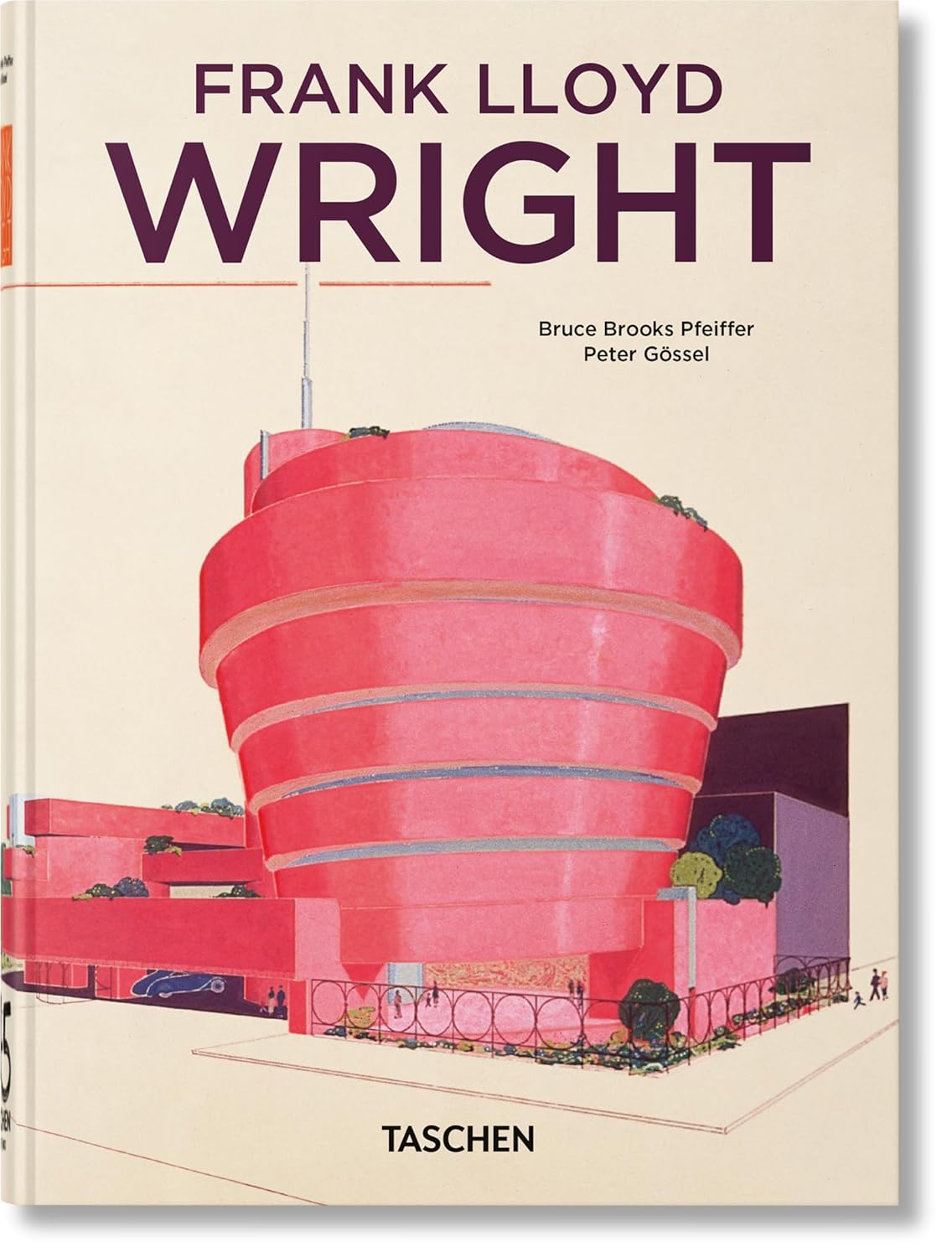
RT: Solomon Guggenheim commissioned it during World War II to house his collection of non-objective art; construction began along the 5th Avenue, between 88th and 89th Street, in the 1950s. Wright went through a lot of different proposals; some of them didn’t look at all like the museum looks right now. It opened in 1959, a few months after Wright died, so he never got the chance to see the inauguration. It is a very ingenious building: visitors take the elevator to the top and walk down a slightly sloping walkway that coils its way down to the bottom, three-quarters of a mile. As visitors walk down, they can admire the artworks—small exhibitions focusing on the development of a painter or a movement over time, because it is displayed chronologically. There is no confusion about which room to go into next and there is also the option of looking back across the big well in the middle to enjoy the already seen works. However, it hasn’t always been used this way. Some non-objective artists did not like the building because they said it minimized, and, in a way, overpowered, their work. And since the building slopes downward, these artists claimed a visitor couldn’t get back easily to see the work again. So there were a lot of complaints from various artists, Jasper Johns among them. In the end, however, the museum has become very popular.
CC: What do you think is Frank Wright’s lasting legacy?
RT: Wright coined the term “Organic Architecture.” That’s one of his legacies, and there are still people who work that way, especially since nowadays energy costs and environmental orientation are so important. Although structures that are built today don’t necessarily look like Wright’s, present-day architects learn from him all sorts of things: how to cross-ventilate a building without air conditioning—for example, by positioning a building so the northwest winds would bounce off it and it, and it would be heated by the sun from southeast.
Wright’s legacy is also individualism; he didn’t go with the flow—so much so that he wouldn’t even join the American Institute of Architects (AIA), which nevertheless awarded him, at the age of 80, its gold medal for lifetime achievement. In the meantime, there were plenty of architects who also received gold medals but couldn’t shine Wright’s shoes, if I could put it that way. The reason why the AIA didn’t recognize him earlier was that Wright was critical of the AIA because he thought it was pandering to the mainstream. He, however, had an independent mindset and he was going his own way, regardless of what other architects were doing. I think this individualism and independence are great lessons for young architects today
Recommended Reading



0 comments