

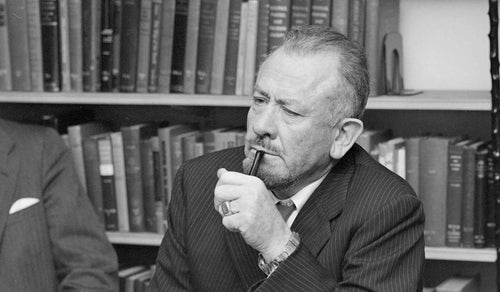
He dressed like a Victorian undertaker, wrote like a 19th-century Jesuit in love with jazz, and filed columns with the precision of a man polishing cathedral glass, even when writing about mob trials, labor rackets, or petty City Hall betrayals.
He wore a three-piece suit to cover police riots, typed with two fingers on a manual Olivetti, and believed that journalism was the last refuge of the gentleman, though he was never entirely sure what a gentleman was. Murray Kempton, the Pulitzer Prize-winning columnist, was a walking contradiction: a radical who distrusted movements, a stylist who loathed affectation, and a moralist who found his sermons in the messy lives of politicians, criminals, and ordinary New Yorkers.
For nearly six decades, Kempton’s columns, first for The New York Post, later for Newsday and The New York Review of Books, elevated the daily grind of reporting into a form of high literature. His prose, dense with allusion and irony, owed as much to Tacitus and Henry James as to the tabloid hustle. He wrote about power with the skepticism of a born outsider, yet his work pulsed with an almost old-fashioned faith in civic virtue. Kempton was not just a journalist but a historian of the present, chronicling the follies of mid-century America with the wit of a satirist and the gravity of a tragedian.
His influence extended beyond the newsroom. Novelists like Norman Mailer admired his psychological depth; poets, including James Merrill, praised his cadences. Academics puzzled over his blend of erudition and street-level observation. Yet Kempton remained stubbornly unclassifiable, a dandy in a rumpled trench coat, a highbrow with a tabloid reporter’s instincts. In an age of shrinking attention spans and partisan screeds, his work stands as a rebuke: proof that journalism can be both urgent and enduring, both timely and timeless.
The Making of a Maverick
Born in Baltimore in 1917 to a middle-class family, James Murray Kempton grew up between worlds, his father a liberal journalist, his mother a Southern belle with aristocratic pretensions. He studied history at Johns Hopkins but dropped out, later claiming he “learned more from the Partisan Review than any professor.” By the 1940s, he was in New York, drifting through leftist circles, writing for The New Republic, and cultivating a persona as the last of the gentleman radicals.
His early work was steeped in the ideological fervor of the era, but the Moscow Trials and the rise of Stalinism soured him on organized leftism. Unlike many of his peers, Kempton never traded one dogma for another. His 1955 book, Part of Our Time: Some Ruins and Monuments of the Thirties, dissected the failures of American communism with a novelist’s eye for character and a historian’s grasp of consequence. It was less a polemic than an elegy, for lost causes, yes, but also for the human beings who had believed in them.
The Art of the Column
Kempton’s true medium was the newspaper column, a form he treated with the seriousness of literature. His pieces were rarely breaking news; instead, they were miniature essays, weaving together courtroom testimony, literary references, and biting asides. He covered the civil rights movement not just as a political struggle but as a moral drama, profiling figures like Martin Luther King Jr. and Malcolm X with equal parts admiration and clear-eyed critique.
His 1973 coverage of the Watergate hearings, later collected in The Briar Patch, was a masterclass in irony. While others framed the scandal as a battle between good and evil, Kempton saw it as a farce of vanity and self-delusion. His portrait of Richard Nixon was withering but oddly compassionate: “a man who wept for himself because no one else would.”
A Writer’s Writer
Kempton’s influence on other writers was profound, if diffuse. Norman Mailer called him “the best mind ever to practice journalism.” Joan Didion admired his ability to “find the universal in the ephemeral.” Among poets, James Merrill and Frank O’Hara borrowed his knack for juxtaposing high culture with vernacular grit.
Academics, meanwhile, struggled to categorize him. Was he a journalist? A moral philosopher? A belletrist? Kempton himself would have scoffed at the distinctions. He saw his work as an extension of the essayistic tradition—Montaigne with a press pass.
The Enduring Anomaly
Kempton died in 1997, just as the digital age was transforming journalism. In some ways, his methods seem antiquated: the deliberate pace, the aversion to sound bites, the insistence on seeing every story as part of a larger human comedy. Yet his work feels more necessary than ever. In an era of algorithm-driven outrage and performative punditry, Kempton’s blend of skepticism and empathy, of style and substance, is a reminder of what journalism can, and should be.
He once wrote that “the press lives by disclosing the secrets of others while keeping its own.” Kempton’s own secrets, if he had any, died with him. What remains is the writing: sharp, humane, and unsparing, a monument to the idea that even the daily news can be literature.


0 comments