

He never raised his voice, but he wrote as if the world depended on listening.
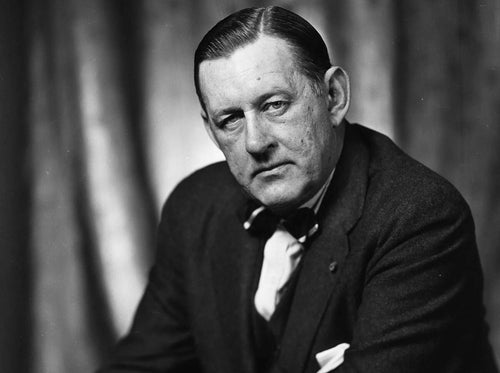
John Hersey had the unfashionable habit of listening. In an age when foreign correspondents roared, roved, and swaggered, Hersey sat—deliberate, dispassionate, almost spectral—with a notebook in his lap and a face so free of affect that some mistook him for a functionary. He was not. He was a moralist in the deepest sense, with a prose style so austere it could have been carved in basalt. Yet beneath the composure lay a keen narrative instinct, honed not for sensation but for clarity, and a conviction that writing well was a form of moral action.
Hersey’s reputation rests on Hiroshima (1946), a book of such quiet devastation that its impact endures even in an era dulled by mass atrocity. It remains the gold standard of literary journalism: fact-checked to a forensic degree, written with a novelist’s control, and stripped of any authorial presence that might mediate the reader’s encounter with the truth. That the truth was radioactive was not incidental. Hersey, who had witnessed war both from the trenches and from the drawing rooms of the American elite, understood that narrative—who tells it, how it’s told—is the first casualty of power. His method was not only a literary innovation; it was a rebuke.
And yet Hersey was not merely a journalist with a novelist’s ear. He was, more broadly, a writer in the classical sense: versatile, exacting, restless. He produced over 20 books in genres ranging from war reportage to campus satire. He wrote about China and Connecticut, about nuclear fallout and Yale bureaucrats, about heroism, failure, race, and education. He served as a war correspondent, a presidential speechwriter, and a teacher. In his fiction, he adopted techniques drawn from poetry and modernism. In his nonfiction, he practiced restraint so radical it bordered on the aesthetic. The resulting oeuvre is not easy to categorize—but neither was the man.
A life of divided worlds
Born on June 17, 1914, in Tientsin, China, to Protestant missionaries, John Richard Hersey spent his early years immersed in a culture that few Americans of his generation could begin to comprehend. Mandarin was his first language. He was raised not in some American compound but within Chinese society, a childhood that seeded his lifelong interest in cultural perspective and moral complexity. His later works—especially A Single Pebble (1956), a novel about a Western engineer’s disillusioning journey up the Yangtze River—would draw on this early tension between East and West, idealism and experience.
Returning to the United States as a boy, Hersey was shaped by elite institutions. He attended Hotchkiss and then Yale, where he edited the Yale Daily News and was admitted to Skull and Bones. He later studied at Cambridge on a Mellon fellowship before joining Time magazine in 1937 as a junior writer under Henry Luce, who had also been born in China to missionaries. War broke out, and Hersey was dispatched to Europe and the Pacific. His war reportage, including a harrowing account of the Guadalcanal campaign, earned him a Pulitzer Prize in 1945 for A Bell for Adano, a novel set in occupied Sicily.
The Pulitzer was no small honor, but Hersey considered it a detour. Fiction, he believed, could speak to emotional truth—but facts mattered more. He returned to journalism with a renewed sense of mission, soon accepting an assignment from The New Yorker that would define his career.
Hiroshima and the invention of silence
The idea behind Hiroshima was simple. On August 6, 1945, the United States dropped an atomic bomb on a Japanese city. What had happened to the people on the ground? The American press had not bothered to ask. Hersey did.
He traveled to Japan in May 1946, conducted interviews with dozens of survivors, and selected six whose experiences would form the spine of his narrative. What followed was a journalistic act of radical empathy. Hersey submerged his voice entirely, offering no authorial commentary, no poetic flourishes, no overt moralizing. Just six human lives, recounted in order and in detail: a young clerk, a doctor, a German Jesuit priest, a widow, another doctor, and a Methodist pastor.
When The New Yorker published the piece in its entirety on August 31, 1946—68 pages of uninterrupted prose—it caused a sensation. Albert Einstein ordered 1,000 copies. American readers, many for the first time, confronted the human consequences of the bomb. The piece was reprinted as a book within months and has never been out of print.
Its influence was both literary and political. Hiroshima demonstrated that journalism could adopt the techniques of fiction without surrendering to its inventions. It did not dramatize; it revealed. It suggested that truth-telling was an act of restraint, not embellishment. And it challenged the American public’s self-conception at a moment when its power seemed unassailable.
A restless, rigorous body of work
Though Hiroshima is his most enduring legacy, Hersey’s broader corpus rewards close study. The Wall (1950), a fictionalized account of the Warsaw Ghetto uprising, blends epistolary narrative with historical fidelity in a way that presaged later experiments by W. G. Sebald. The Algiers Motel Incident (1968), a chilling examination of the murder of three Black teenagers during the Detroit riots, marked one of the earliest serious journalistic treatments of systemic police violence. The Child Buyer (1960) used speculative fiction to satirize American education and bureaucratic inhumanity; it reads today like a dystopian prophecy.
Hersey’s work also exhibits a surprisingly poetic sensibility. Though he rarely wrote poetry himself, his prose rhythms and imagistic discipline reflect a poetic training. His sentences are careful, metered, and often arresting in their simplicity. He was an admirer of Hemingway, yes, but also of Eliot and Auden. The latter influence is particularly felt in his experiments with form—such as Life Sketches (1981), a suite of short stories presented as obituaries—and in his cool, slightly ironic detachment.
This detachment was not emotional apathy but moral clarity. Hersey believed that emotion in writing should emerge from detail, not display. His avoidance of sentimentality—particularly striking in his war reporting—was not a failure of feeling but a refusal to manipulate. “What has been done cannot be undone,” he once said, quoting Lady Macbeth not to indict but to reflect.
Teaching, legacy, and the long view
In later years, Hersey turned increasingly to teaching and public service. He became Master of Pierson College at Yale in 1965, a role he held until 1970, and later taught at the university for many years. His teaching style was famously unadorned: no theatrics, no indulgent praise, but a fierce commitment to revision and to the idea that writing is work. Among his students was David Remnick, now editor of The New Yorker, who has cited Hersey as a formative influence.
Though he was sometimes criticized for lacking a strong ideological bent—he was neither New Left nor conservative, neither revolutionary nor reactionary—Hersey’s deeper commitments were unmistakable. He believed in human dignity, in the value of bearing witness, and in the necessity of clear prose. He was, above all, a practitioner of decency, in a time and a country that too often rewarded its opposite.
He died on March 24, 1993, in Key West, Florida, where he had spent his final years writing and sailing. The obituaries were respectful but somewhat muted—fitting, perhaps, for a writer who had spent his life making others’ stories louder than his own.
The enduring method
John Hersey’s legacy lies not only in his books but in his method—what might be called narrative integrity. At a moment when nonfiction was still wrestling with its identity, Hersey showed that it could be both factual and artful, rigorous and readable, emotionally potent without being emotionally manipulative. He wrote against the grain of spectacle and ego, and in doing so, he helped to define a standard of nonfiction that remains elusive but essential.
His influence is visible today in the best long-form journalism, in writers like Katherine Boo, Lawrence Wright, and Alex Kotlowitz, who adopt Hersey’s approach of immersive, empathetic reportage. It is also evident in the renewed interest in so-called “slow journalism,” which privileges accuracy, depth, and moral seriousness over speed.
In an age of hot takes and fast clicks, Hersey’s work offers a different model: of attention, of care, of listening. He wrote as if words mattered, because for the people whose stories he told, they did. In this sense, his writing continues to perform what it always intended—to humanize, to witness, to endure.

0 comments