

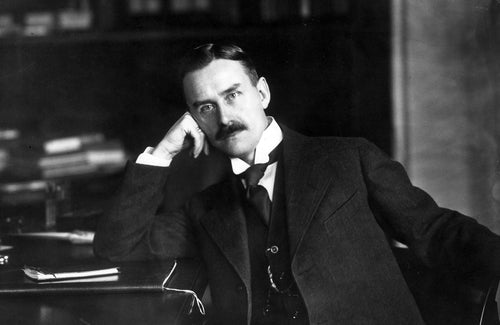
January 1st is not only the beginning of a new year, but also the anniversary of the birth of one of the most esteemed figures in English literature, E. M. Forster. Born on this day in 1879, Edward Morgan Forster became one of the most significant writers of the early 20th century, celebrated for his keen social insight, intricate character studies, and exploration of themes such as class, sexuality, and human connection. In honor of his birthday, let’s delve into the life and legacy of this literary giant.
Early Life and Education
Forster was born in London into a middle-class family with a strong intellectual heritage. His father, an architect, died when he was just a year old, leaving his mother to raise him. Forster’s childhood was marked by a close relationship with his mother and a series of trips to the English countryside, where he would develop a lifelong affection for nature and the rural world. He was educated at the prestigious Tonbridge School before attending King's College, Cambridge, where he was deeply influenced by his experiences with the intellectual and creative circles of the time.
It was at Cambridge that Forster began to develop his literary talents, becoming involved with the Cambridge Apostles, a secret society of intellectuals, and forging friendships with notable figures such as the writer Lytton Strachey and the economist Maynard Keynes. His time at university shaped his understanding of social dynamics, which would later inform much of his writing.
Literary Career: Themes of Social Class and Human Connection

Forster’s debut novel, Where Angels Fear to Tread (1905), set the tone for his future works. It explored the tension between British society and the Italian world through the story of an English woman who marries an Italian man, only to suffer the consequences of cultural misunderstandings and societal expectations. The novel touches on the themes of social class, individual freedom, and the clash between tradition and modernity that would become recurring elements in Forster's writing.
However, it was A Room with a View (1908) that cemented Forster’s place as a master of English literature. This coming-of-age story of Lucy Honeychurch, a young woman torn between the repressed, conventional life of Edwardian England and a more liberated existence in Italy, skillfully critiques the rigidity of class boundaries and societal expectations. The novel also delves into the complexities of love and self-realization, blending humor with profound social commentary.
Forster’s most famous novel, Howards End (1910), takes these themes even further, exploring the conflict between the wealthy Wilcox family and the intellectual, idealistic Schlegels. The novel examines the divisions in English society during a time of social and economic change. It is renowned for its portrayal of women’s roles and the complex relationships between characters, all woven together by the concept of howards end—the house that symbolizes the blending of social classes, as well as the enduring nature of human connections.
Another one of Forster’s masterpieces, A Passage to India (1924), stands as a profound commentary on British imperialism. Set in British-occupied India, it explores the cultural misunderstandings and racial tensions between the colonizers and the colonized. The novel addresses themes of identity, alienation, and the inability to truly understand another culture, making it one of Forster’s most significant works in terms of its global perspective.
Personal Life and Views

Though Forster is known for his incisive social critiques, his personal life also played a significant role in shaping his work. Forster was openly gay, though his sexuality was something he largely kept private during his lifetime. Much of his work, particularly his later novels, reflects his deep interest in the fluidity of sexual identity and human connection. His personal experiences with love, desire, and friendship influenced his exploration of sexual liberation and individual freedom.
Forster’s sexuality also informed his commitment to progressive social causes. He was deeply opposed to the British class system and was a vocal advocate for social equality. His political leanings leaned left, and he was an outspoken critic of British imperialism. However, his works are not overtly political; instead, they express these concerns through the subtle interactions of characters and the portrayal of societal pressures.
In addition to his literary pursuits, Forster worked as a lecturer, a social critic, and an essayist, contributing to numerous publications and even serving as a social worker in London during World War I. His experiences with social work would influence his thoughts on social reform and human rights.
Later Life and Legacy
Today, Forster’s work continues to resonate with readers around the world. His exploration of complex emotional lives and social issues, along with his critique of class and imperialism, has ensured his place as one of the great English novelists of the 20th century. His ability to reveal the depths of human connection—whether through friendship, love, or societal struggle—remains a hallmark of his writing.
Forster’s later years were marked by a shift in his literary output. After A Passage to India, he published very little, largely focusing on his essays and his personal life. He lived much of his later life in Cambridge, where he became a notable figure in the university's intellectual community. Forster died in 1970 at the age of 91, leaving behind a remarkable legacy of novels, essays, and short stories.
Forster’s Enduring Influence

Though E. M. Forster's work has been largely shaped by the Edwardian and interwar periods, its relevance endures. His novels continue to inspire adaptations, critical studies, and public discussions on the nature of human relationships and societal structures. Howards End, A Room with a View, and A Passage to India have all been adapted into successful films and stage productions, cementing their status as cultural touchstones.
As we celebrate his birthday today, it is fitting to reflect on the breadth of Forster’s contributions to the world of literature. His insights into human behavior, his exploration of social divides, and his championing of individual freedoms make his works timeless. Whether read for their richly developed characters, their vivid settings, or their social commentary, Forster’s novels remain essential reading for anyone interested in the complexity of human life.
On this day, January 1, 2025, we honor E. M. Forster, whose literary genius continues to illuminate the complexities of our shared human experience. From his exploration of societal norms and class struggles to his nuanced portrayals of love and human relationships, Forster's work remains as relevant today as it was when it was first published. His legacy lives on, inspiring new generations of readers and writers alike.


0 comments